Stowers scientists overcome key barrier to grow blood stem cells needed for transplants in Leukemia patients
A new lab-culture system preserves the long-term power of umbilical cord-blood stem cells, opening a first-of-its-kind path toward transplant options to treat cancers and other disorders of the blood.
06 November 2026
KANSAS CITY, MO—November 6, 2026— Scientists at the Stowers Institute for Medical Research have developed a laboratory culture system that multiplies blood-forming stem cells from human umbilical cord blood while preserving their ability to rebuild a person’s blood and immune systems. The discovery in mice and human cells solves a longstanding obstacle in stem cell transplantation and removes a major barrier in the ability to treat cancers like Leukemia and other disorders of the blood.
The new, landmark study from the lab of Stowers Investigator Linheng Li, Ph.D., tackles a problem that has frustrated the field for decades: How do you grow blood-forming stem cells that remain stem cells, rather than ones that mature into specialized blood cells? Scientists have failed to find a way to grow a specific kind of stem cell in the lab without causing them to lose the properties that make them valuable, until now.
Published in BLOOD, on November 5, 2026, the research centers around hematopoietic stem cells, or HSCs. These “master cells” are found in bone marrow and umbilical cord blood and give rise to every blood and immune cell type. They are required to achieve successful transplantation for patients with leukemia and other blood disorders. A single banked cord-blood unit, however, often contains too few stem cells to treat an adult patient.
“Therein lies the catch-22. The question I’m asking is, conceptually, how can a stem cell self-renew without differentiating?” said Li, who led the study with Postdoctoral Research Associate Xinjian Mao, Ph.D., “Self-renewal requires cell division, but division’s default path pushes cells toward maturing instead of renewing themselves.”
That distinction matters because cells can retain the surface markers associated with stem cells while losing the ability to renew themselves and produce a balanced supply of blood and immune cells over the long term. For decades, many labs have reported expanding hematopoietic stem cells, but in those studies, while cell numbers increased, quality dropped.
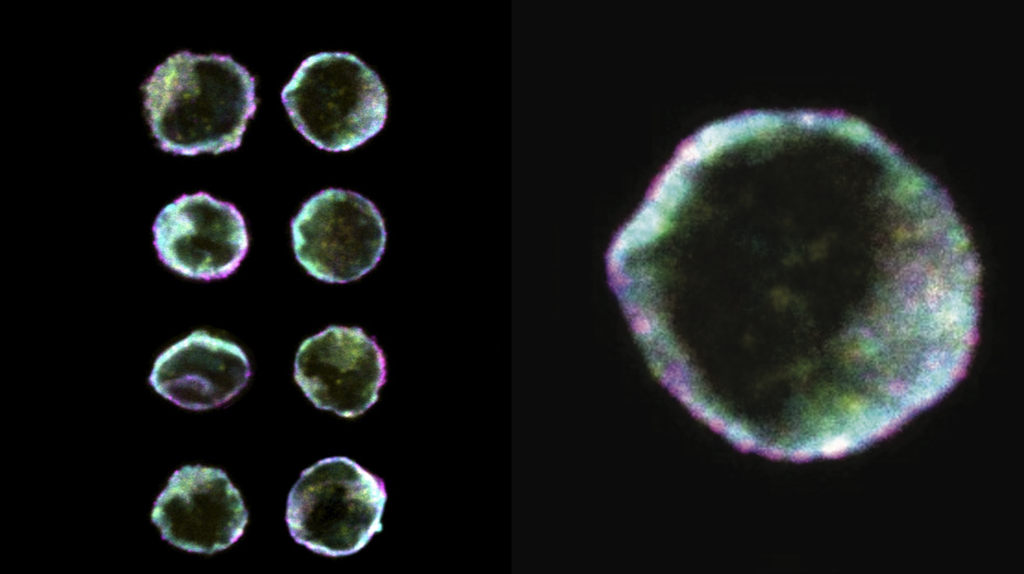
A new 3D gel culture that mimics the bone marrow allows human blood stem cells to multiply in the lab while keeping their long-term regenerative abilities and balanced potential to become different blood cell types.
Drawing on more than two decades of Li’s research into the bone marrow “niche," the environment that shelters stem cells inside the body, the team successfully designed a culture system that recreates several of its protective signals at once.
“The central challenge was not simply producing more cells,” Li said. “The cells must remain true long-term stem cells that can renew themselves and generate a balanced blood and immune system. Quality is as important as preserving quantity.”
The Li Lab’s new system does this by combining a three-dimensional scaffold with signals that help keep stem cells from becoming overactivated and maturing too quickly, along with a compound that promotes their expansion. Together, the components allowed the cells to multiply while preserving the characteristics of true long-term stem cells.
The team built the system step by step, adding one factor at a time and testing its effect, and the final combination of elements gave the best results, suggesting that preserving stem cell identity benefits from recreating multiple aspects of the natural bone marrow environment rather than relying on a single signal.
"Transplantation is a life-saving treatment,” said Li, “but for decades, expanding stem cells for this purpose has been a bottleneck. Our work shows we can expand high-quality, long-term hematopoietic stem cells with real potential for clinical use. It's exciting to think about where this could lead."
Linheng Li, Ph.D.
The team is also collaborating with the University of Kansas Medical Center, planning for a phase 1 clinical study. The study applies related stem-cell expansion principles to test whether expanded blood-forming cells can help patients recover blood counts following CAR-T cell therapy, an advanced type of gene and immunotherapy that reprograms a patient's own immune cells to find and destroy cancer cells.
What the new system achieved
After 12 days in culture, the new system, when introduced in mice, expanded functional short-term stem cells nearly 12-fold, and true long-term stem cells more than threefold, compared with freshly isolated cells.
To determine whether the expanded cells were genuinely long-term stem cells — rather than simply cells displaying the right markers — the team used serial transplantation, considered the field’s gold-standard test. Cells were transplanted into one group of mice and later transferred into a second group. Only cells capable of continuing to rebuild the blood and immune systems after that second transplantation qualify as true long-term stem cells.
Mice receiving the expanded cells also recovered natural killer cells, neutrophils, and platelets earlier than mice receiving unexpanded cells.
“To know whether we had preserved a true long-term stem cell, we had to look beyond surface markers and test what the cells could actually do,” Mao said. “Serial transplantation allowed us to determine whether the cells could continue rebuilding the blood system over time.”
What’s next
“This project took more than eight years and involved more than 500 mice and more than 100 cord-blood samples,” Mao said. “Our goal was to translate what we’ve learned about how stem cells are protected inside the body into a system that can preserve them outside the body.”
The approach has been tested in human cells and mice but not yet as a cord-blood transplantation treatment in patients. Additional manufacturing, safety, and clinical studies will be required before the system could be used clinically. If the cord-blood approach is validated and scaled for transplantation, it could make banked cord blood available to more patients, including adults who currently cannot receive enough stem cells from a single donated unit.
Additional authors: Ning Zhang, Xi He, Ruochen Dong, Zhe Yang, Michael Epp, Mark Hembree, Linda Zhang, Yiran Meng, Allison Scott, Kate Hall, Anoja Perera, Jose Javier, Amanda Kroesen, Zulin Yu, Shengping Huang, Seth Malloy, Jeffrey Haug, Hua Li, Negin Manshour, Dong Xu, Cheng Luo, William Greenleaf, Toshio Suda, Claus Nerlov, and Chuan He.
This work was funded by the Stowers Institute for Medical Research. Xinjian Mao was a recipient of an American Society of Hematology Fellow Scholar Award. The authors also acknowledge the University of Kansas Medical Center Genomics Core for sequencing support.
About the Stowers Institute for Medical Research
Founded in 1994 through the generosity of Jim Stowers, founder of American Century Investments, and his wife, Virginia, the Stowers Institute for Medical Research is a nonprofit biomedical research organization with a focus on foundational research. Its mission is to expand our understanding of the secrets of life and improve life's quality through innovative approaches to the causes, treatment, and prevention of diseases.
The Institute consists of 25 independent research programs. Of the approximately 500 members, over 370 are scientific staff, including principal investigators, fellows, technology center directors, postdoctoral scientists, graduate students, and technical support staff. Learn more at www.stowers.org and www.stowers.org/gradschool.
Media Contact:
Joe Chiodo Director of Communications 724-462-8529 jchiodo@stowers.org