Partners in innovative education: How the Stowers Graduate School and the Stowers Institute are inherently aligned
An interview with Stowers Graduate School President Emeritus Betty Drees
12 December 2024
Stowers Graduate School President Matt Gibson, Ph.D., with President Emeritus Betty Drees, M.D.
In 2018, Betty Drees, M.D., FACP, FACE, joined the Graduate School of the Stowers Institute for Medical Research as President. Launched in 2012, the Graduate School was fairly new, with around 40 predoctoral researchers, taught by faculty members who were investigators and scientists from the Stowers Institute. The Graduate School has a distinct role—education. However, the Graduate School and the Institute are inherently connected through faculty, facilities, and funding.
Drees is a physician specializing in diabetes, a researcher, a faculty member at the University of Missouri, Kansas City (UMKC), and former 13-year Dean of Medicine at UMKC. As the new president, Drees was tasked to provide guidance, expertise, and experience in spearheading the Stowers Graduate School and carrying it through the external validation process of accreditation while maintaining the integrity and mission of its original design.
As she prepared to step down as President, an interview with Drees shed light on her accomplishments, leadership, and vision for upholding the distinguishing features that make the Stowers Graduate School truly unique.
Earning accreditation for the Graduate School was a significant goal and feat—what were some of the challenges and highlights?
Prior to accreditation, the Graduate School was certified by the Missouri Department of Higher Education to operate as a higher education institution, a certification process that must be reapplied for annually.
Accreditation assures a quality of education that requires strict criteria to be met, including institutional structures and policies, curriculum, and how our students are selected and evaluated. The process to become fully accredited took around six years, which is very fast compared to the average timeline. The evaluation covered everything from our articles of incorporation, bylaws, and policies, to the formal definition of the Graduate School’s relationship with the Institute. As the education entity, we are separate but very much connected. Our mission to prepare future scientists through education is completely aligned with the vision and mission of the Institute—to make a significant contribution to humanity through biomedical research—which needs the next generation of scientific leaders. A large portion of this process was done during the COVID-19 pandemic, which demonstrates the dedication of the students, the commitment of the faculty, and the support of the administration.
Initial accreditation was awarded to the Graduate School in November 2021 by the Higher Learning Commission (HLC), a regional accreditation agency recognized by the U.S. Department of Education. For any education institution, how you assess your program, how you use that assessment to continually improve, and how you use that to align your resources is the biggest challenge. Because final accreditation cannot be awarded until the program has generated graduates, you need to work diligently until you have a group of graduates—the proof of a successful education program—that shows you have succeeded.
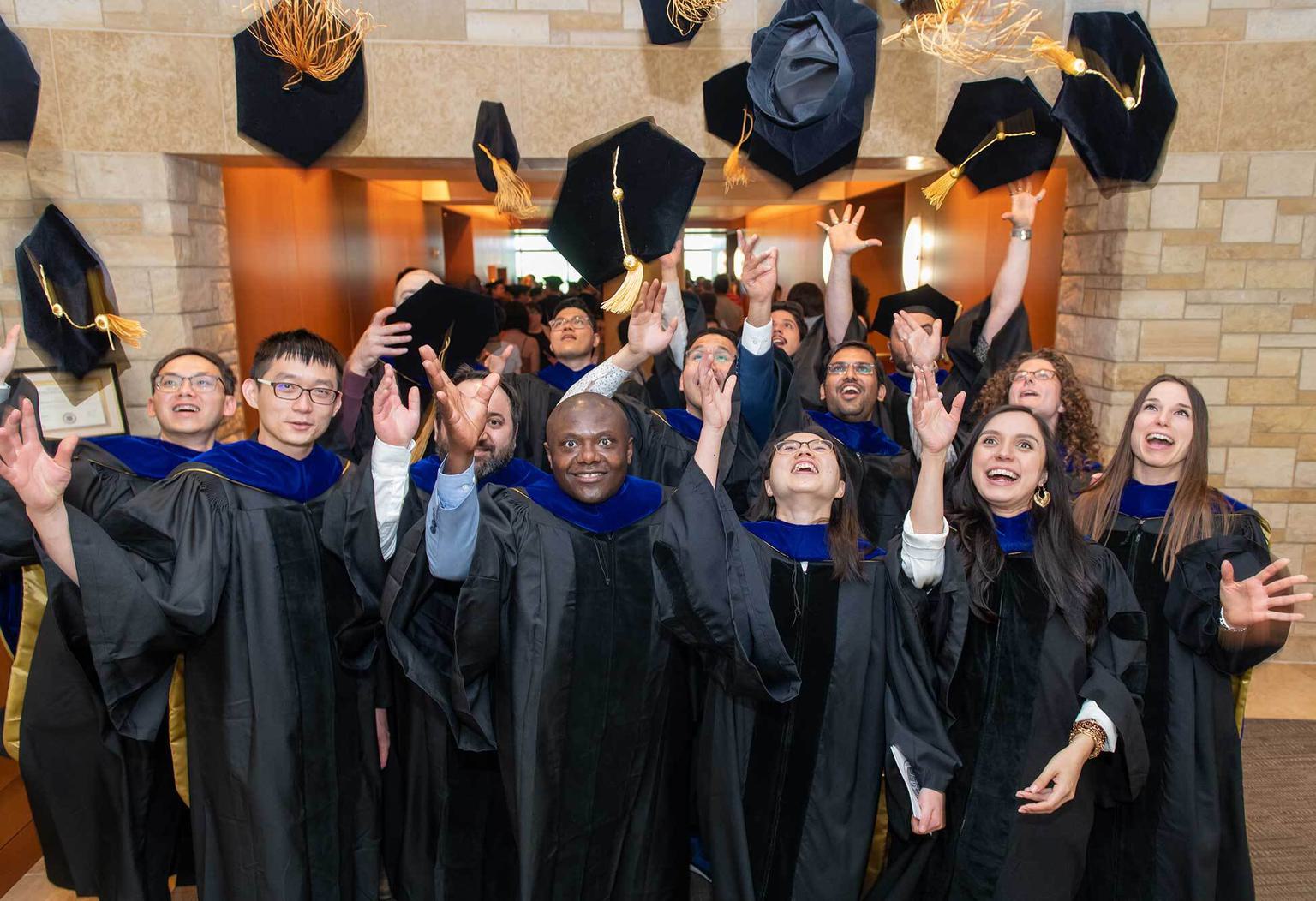
The 2023 Graduation ceremony.
What were the most rewarding or defining moments during your tenure as President?
The 2023 Graduation ceremony, our first since the pandemic, was very much a highlight of my time as President. Having three years of graduates return to participate in the first post-pandemic ceremony allowed us to really see the impact. Seeing the success of these early career scientists and knowing that you have prepared them well is a physical, emotional validation that we are doing things right, distinct from the intellectual validation of accreditation. That for me was the most rewarding moment.
I am also very proud that we have predoctoral researchers on almost every committee, including those that oversee curriculum, assessment, admissions, and strategic planning. In addition, our predoctoral researchers have established their own graduate student council. Along with faculty and administrative participation, student participation in the program’s governance is essential—they are our future peers.
From your perspective as a long-time academic administrator, researcher, and leader in education, what makes the Stowers Graduate School a special place to earn a Ph.D.?
The advantage of opening a new education program is that you can design it the way you think it should be done rather than being constrained by the way something has been done for 200 years. We provide a contemporary, hands-on, experiential learning program. Because we are a small institution focused on biomedical research, the curriculum is tailored to a biomedical research education—the graduate courses are innovative and target the specific preparation predoctoral researchers need. There is no substitute for that.
The Graduate School distinguishes itself by the excellence of our education, meaning the facilities, the curriculum, the research environment, the faculty, and the level of support. The quality of our graduates is the proof of what we are doing here.
What are your hopes for the school’s future and for the new President Matt Gibson, Ph.D.?
A big part of my responsibilities over the past six years was to prepare us for and shepherd us through accreditation. With Dr. Gibson as President, he can focus on other aspects of the role, such as strategic planning and external relations. The Graduate School is functioning at a very high level, and I think we will continue to improve. Dr. Gibson is an excellent fit for the school’s future because he is effective in telling the story of the Graduate School’s role in linking science with education. I feel very confident in his leadership.
Stepping down as President was a natural transition point. Our governance policies are in place. There are no big changes in Institute leadership. We’re through the COVID-19 pandemic. It was the right time for the school and the right time for me personally.
This story is the second in a series about the origins and distinct nature of the Stowers Graduate School. Read the first story here.