In The News


29 September 2026
Rapidly Evolving Aphid Proteins Share a Common Structural Blueprint
From Technology Networks: The Stern Lab reveals a shared structural blueprint among thousands of rapidly evolving aphid proteins.
Read Article
News
Research from the lab of Stowers Investigator Matt Gibson, PhD was recently featured in an article in the September 2022 issue of Scientific American.
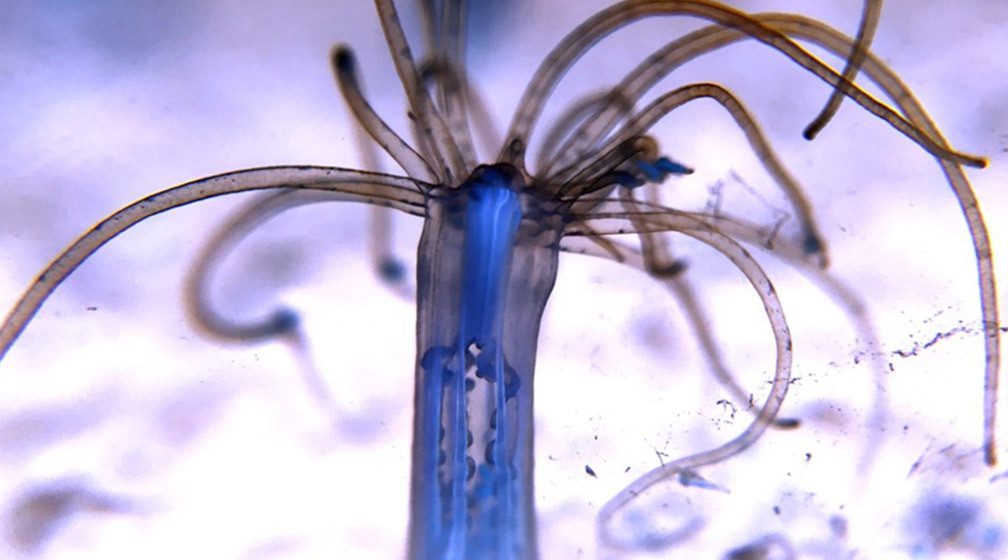

Research from the lab of Stowers Investigator Matt Gibson, PhD was recently featured in an article in the September 2022 issue of Scientific American.
Below is an excerpt from the article.
Jellyfish, sea anemones and corals, a group called cnidarians, sting with tiny, pressurized capsules that fire poisonous darts at explosive speeds. Researchers have been unsure of the exact mechanics of this blisteringly fast process, which occurs using special cell organelles called nematocysts. Now a team led by Matt Gibson and Ahmet Karabulut of the Stowers Institute for Medical Research in Kansas City, Mo., has used cutting-edge imaging technology to study nematocyst firing in very fine detail. Understanding the biophysics of what they call “one of nature's most exquisite biological micromachines” could inspire the design of minuscule drug-delivery devices, the researchers say.
Read the full article here.
In The News
29 September 2026
From Technology Networks: The Stern Lab reveals a shared structural blueprint among thousands of rapidly evolving aphid proteins.
Read Article
In The News


24 September 2026
From Phys.org: The Stern Lab reveals how evolution helped AI predict the structures of thousands of rapidly evolving aphid proteins.
Read Article
Press Release
22 September 2026
In an evolutionary arms race with plants, aphids deploy thousands of rapidly evolving proteins. A team led by Stowers Institute and HHMI Investigator David Stern, Ph.D., discovered a shared architecture beneath them and revealed how evolution can help AI predict similar protein structures across biology.
Read Article
News


15 September 2026
New single-cell atlas of the acorn worm shows that most tissues undergo a genome-wide transcriptional overhaul as larva becomes adult, providing new insights into how some organisms remake their bodies in ways humans can’t.
Read Article
