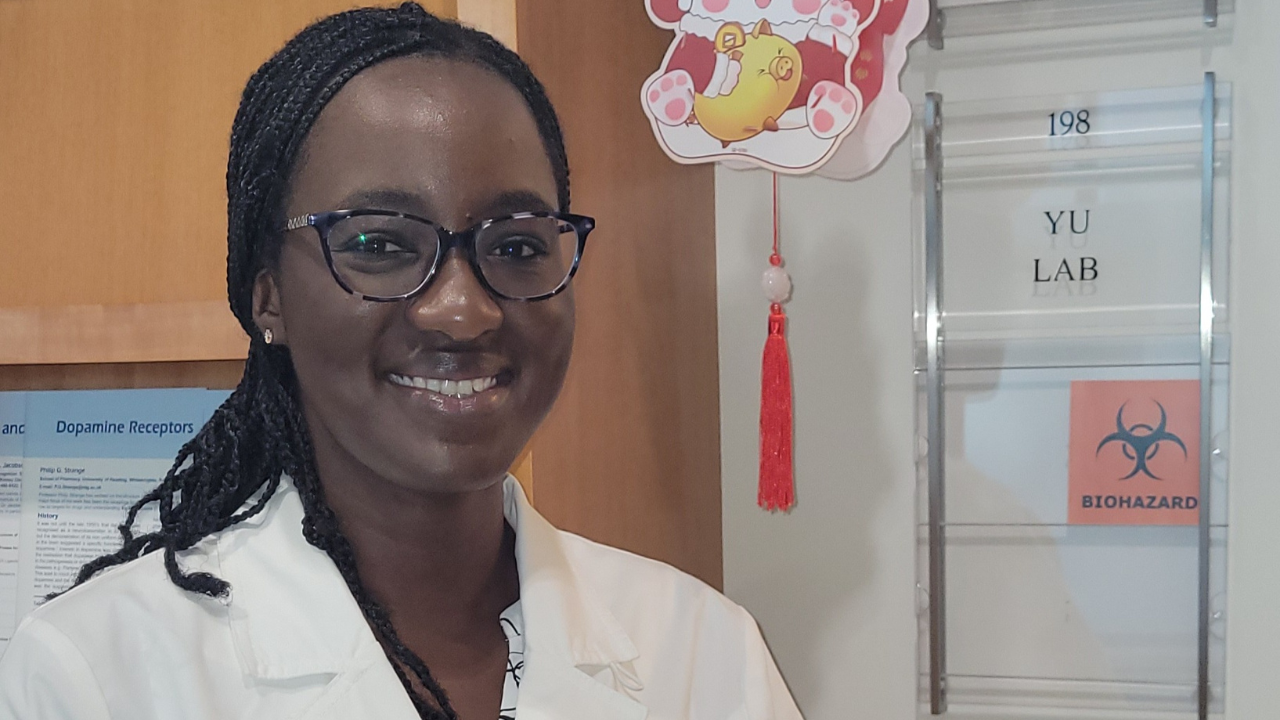
What is your current research focus and why?
My current research focuses on understanding how olfaction, commonly known as the sense of smell, regulates mammalian social behaviors. Specifically, I am using the mouse as an animal model to determine the functional role of a set of pheromone receptors underlying innate reproductive and parental behaviors. These innate behaviors are not learned but are genetically hardwired and displayed instinctively in response to specific pheromone signals. Pheromones are chemical cues that are released from urine, sweat, and other bodily fluids, and they convey information about the age, sex, reproductive status, and health status of an individual. I am also utilizing various genetic and microscopy tools to delineate neural pathways that process the pheromone information detected by the receptors of interest. Given that social behaviors contribute to the overall health and survival of animals as individuals and species, it is essential to study and understand how the brain processes olfactory sensory information and controls odor-evoked social behaviors.
Growing up, what career did you want to pursue?
When I was growing up, I wanted to become a medical doctor. However, as I got older and took more science classes, I found myself drawn more toward the research side of science. I enjoy exploring novel concepts and conducting experiments that promise to uncover new insights into fundamental biology.
When and how did you become interested in a career in science?
Science-related subjects have always piqued my interest. Starting from primary school in Zimbabwe, I loved learning about different animals and plants. I enjoyed the practical side of my science classes, whether we were observing something outdoors or doing hands-on experiments on plant growth. By the time I was in high school, I was confident that I would pursue a career in science. My passion for biology, especially learning about development and how the human body works, led me to where I am today.
What made you decide to join the Yu lab at the Stowers Institute?
During my Ph.D. at the University of Kansas, I had many opportunities to interact with scientists from the Stowers Institute at seminars and conferences that were hosted by K-INBRE and the University of Kansas Cancer Center. I was fascinated by the research presentations that the Stowers Institute’s scientists gave, particularly the cutting-edge techniques and instrumentation they were using. Consequently, the Stowers Institute was at the top of the list for my postdoc training. I decided to join the Yu Lab because of my neuroscience and molecular biology research background. I have always been intrigued by the brain and its complexities. The opportunity to study how the brain controls odor-induced behaviors alongside the great scientists in the Yu Lab and the Institute was too great to pass up. I hope to make meaningful contributions to the Yu Lab and the olfactory neuroscience field during my time at the Stowers Institute.
What is your favorite non-research-related memory at the Stowers Institute so far?
Always getting the best workplace coffee from the Institute’s espresso machine!
What is your favorite thing to do in Kansas City?
I like visiting the museums here in Kansas City. I mostly enjoy the different exhibitions that are showcased at the Nelson-Atkins Museum of Art.
Where do you see yourself in 10 years?
I am interested in a research and development career path; therefore, I am aiming for an academic or industry position that will allow me to make an impactful contribution to improving human health.
What advice do you have for other people curious about a career in science?
Network with people in your field of interest to learn more about what it takes to pursue your desired career. If possible, do internships early in your journey to get more practical experience.
To read more Postdoc Profiles, click here.