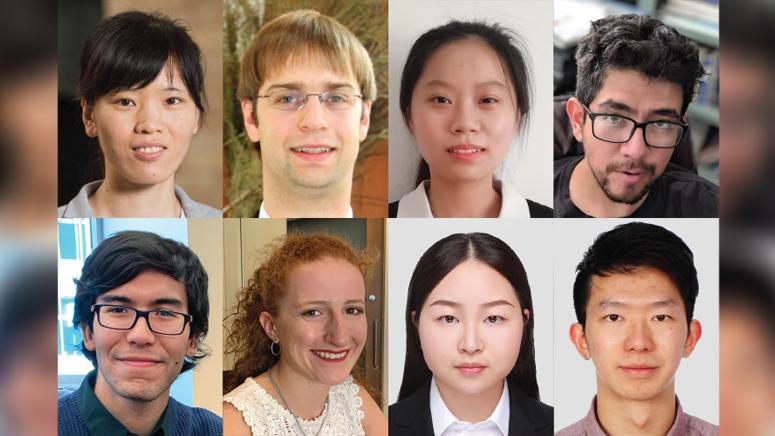
Minling Hu
Beijing Normal University
Minling Hu worked as a research technician in the Halfmann Lab for two years, so when she decided to pursue a PhD, she knew she wanted it to be at the Stowers Graduate School. Hu attended Lanzhou University for her undergraduate work and Beijing Normal University for a master’s program in translational science.
AJ Treichel
Winona State University
As a child, AJ Treichel spent a lot of time outdoors watching tadpoles and caterpillars transform into frogs and butterflies. Later, watching a zebrafish embryo divide again and again, he realized he could make a career out of being curious about the natural world. Treichel attended Winona State University in Minnesota where he received a Bachelor of Science in cell and molecular biology.
Fanning Xia
Wuhan University
Fanning Xia has been fascinated by biology since high school and originally planned to go into the medical field, but discovered she was afraid of holding a scalpel. Shifting to biology and research felt like a natural choice. She attended Wuhan University for her Bachelor of Science degree.
Carlos Barradas Chacón
National Polytechnic Institute of Mexico
Carlos Barradas Chacón grew up in León, Mexico, where he found peace watching nature documentaries. He hopes to someday study regeneration in Ambystoma mexicanum, the axolotl. Barradas Chacón attended Autonomous University of Queretaro and National Polytechnic Institute of Mexico.
Pablo Guzmán Palma
Pontifical Catholic University
Pablo Guzmán Palma chose his career path when he learned how to use a microscope in high school. He was “fascinated by the shapes and colors of plant cells, by how microorganisms move under the lens.” Guzmán Palma earned his Bachelor of Science and post-bachelor’s degrees in biochemistry at Pontifical Catholic University.
Camila Behrensen
Universidad Argentina de la Empresa
Camila Behrensen might have Isaac Asimov to thank for her love of science. While growing up, Asimov was her favorite author, in part because of how he was able to explain complicated concepts in ways that everyone could understand. She received her Bachelor of Science in biotechnology from the Universidad Argentina de la Empresa.
Kaili Li Sun
Yat-sen University
Kaili (pronounced Kelly) Li first became interested in science when she participated in a biology competition during high school, then got really hooked after reading “On the Origin of Species.” Li earned her bachelor’s degree in bioengineering from Henan Agricultural University and her master’s in cell biology from Sun Yat-sen University.
Haining (Frank) Jiang
Shanghai Jiao Tong University
Haining (Frank) Jiang was the type of kid who loved to take things apart just to see how they work. That same curiosity led him to study biology and medicine in high school and at Shanghai Jiao Tong University, where he received a Bachelor of Science in biomedical science and experience working on cancer epigenetics.