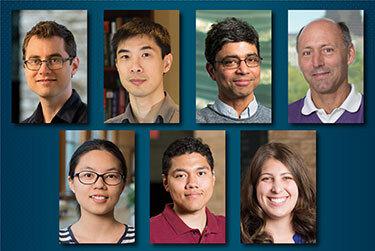
The American Cancer Society awarded a Research Scholar Grant to Assistant Investigator Randal Halfmann, PhD. The three-year grant is related to his work on the role of protein aggregation in cancer-promoting inflammation. Finally, Director of Imaging Paul Kulesa, PhD, received a one-year grant from the St. Baldrick’s Foundation for his research on a platform to enhance neuroblastoma prediction.
Two Stowers predoctoral researchers were also recipients of grant funding. Qiushuang Wu and Alex Rodriguez Gama each received an NIH Predoctoral to Postdoctoral Fellow Transition Award (F99/K00). The two-phase award provides two years of funding for predoctoral research, with four years’ additional support for a postdoctoral position. For Wu, a member of the Bazzini Lab, the fellowship will support her research on mechanisms of protein translation. In the Halfmann Lab, Rodriguez Gama is studying the role of protein self-assembly in the innate immune system.
Most recently, Hawley Lab Postdoctoral Researcher Katie Billmyre, PhD, was awarded a Pathway to Independence (K99/R00) fellowship from the NIH. This five-year award is designed to support researchers as they transition from mentored postdoctoral roles into independent research positions. Billmyre, who received a DeLill Nasser award for Professional Development in Genetics from the Genetics Society of America, studies the molecular and cellular mechanisms behind chromosome-specific behaviors during meiosis.
About the Stowers Institute for Medical Research
The Stowers Institute for Medical Research is a non-profit, basic biomedical research organization dedicated to basic research – the critical first step in the quest for new medical diagnostics, therapies and treatments. Jim Stowers, founder of American Century Investments, and his wife, Virginia, opened the Institute in 2000. Since then, the Institute has spent over one billion dollars in pursuit of its mission.
Currently, the Institute is home to about 500 researchers and support personnel, over 20 independent research programs, and more than a dozen technology development and core facilities. Learn more about the Institute at www.stowers.org and about its graduate program at www.stowers.org/gradschool.