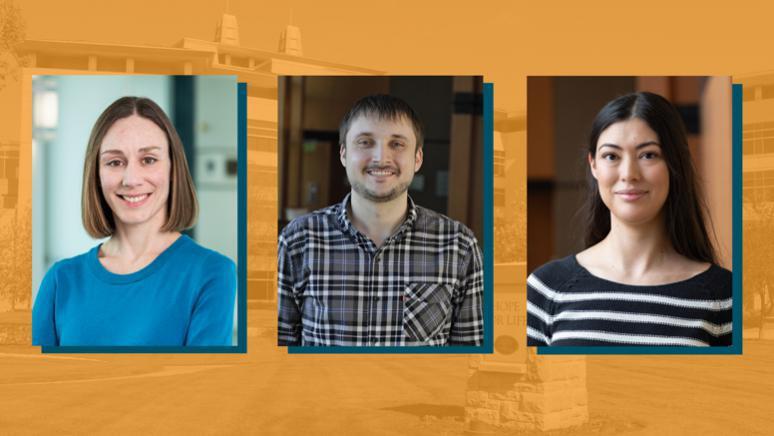
Three postdocs presented with funding notifications
Kristin Watt, Curtis Bacon, Jasmin Camacho receive notification of funding.
12 August 2021
Kristin Watt, Curtis Bacon, Jasmin Camacho
Kristin Watt, PhD, received a prestigious Pathway to Independence grant from the National Institutes of Health (NIH) in August 2021. The award is designed to provide transitional support from a postdoctoral position to an independent faculty position and offers $200,000 over two years at the postdoctoral level with the opportunity for an additional three years of funding at the researcher’s next institute.
Watt is a postdoc in the Trainor Lab who is studying the process and impact of RNA Polymerase III transcription in neural crest cell (NCC) and craniofacial development. Craniofacial anomalies account for one third of all birth defects and are a significant cause of infant mortality. Neural crest cells give rise to the majority of craniofacial bone, cartilage, and connective tissue and understanding their development is crucial for advancing the prevention of craniofacial birth defects. Disruptions in NCC development are known to underlie several craniofacial disorders, and Watts aims to generate a new understanding of the role of Pol III transcription specifically in NCC.
The National Science Foundation announced fellowships for two Stowers postdoctoral researchers in 2021. These Postdoctoral Research Fellowships in Biology are offered to early-career postdocs and provide $138,000 over two years to support the postdoc’s research project.
Rohner Lab Postdoc Jasmin Camacho, PhD, received her NSF award on July 1, 2021. Camacho’s research involves the study of nectarivory, or the exclusive eating of sugar-rich floral nectar, which she believes is an ideal system to investigate physiological adaptations to extreme environmental stress. Specifically, her project aims to investigate nectar bats for their unique metabolic traits necessary for consuming excessive amounts of liquid sugar every day. Camacho believes using an uncommon research organism such as bats is a unique and significant tool for helping to fight metabolic syndromes like hyperglycemia and glucotoxicity, which increase risks of heart disease and diabetes.
In the Zeitlinger Lab, Curtis Bacon, PhD, received a fellowship that will begin January 1, 2022. His project focuses on deciphering how transcription factors interpret the cis-regulatory code during mouse embryogenesis. He and another lab member aim to develop and implement ChIP-next, a sequencing method, to reduce the amount of starting material necessary to obtain transcription factor binding locations and, at the same time, collect chromatin accessibility information. Using ChIP-next data, he will also utilize a deep learning model developed in the Zeitlinger Lab to predict how chromatin accessibility influences the DNA sequences critical for transcription factor binding, which could advance knowledge of how variations in DNA sequence lead to observable phenotypes in development.