“Sauka-Spengler and her collaborators have developed a meaningfully different way to process this kind of data,” said Stowers President and Chief Scientific Officer Alejandro Sánchez Alvarado, Ph.D. “It allows us to infer the most likely path of each component through space and time, and to use deep learning to predict those dynamics and test them experimentally.”
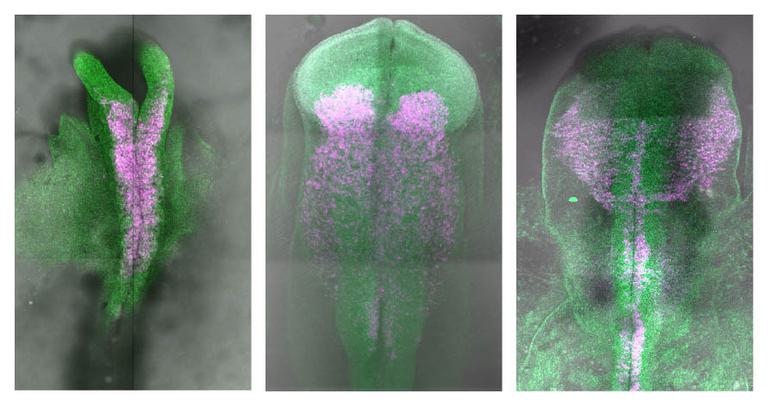
In the study, RegVelo modeled the neural crest, a group of early embryonic cells that can become many different parts of the body. In zebrafish neural crest development, RegVelo identified an early driver of pigment cell formation (tfec) and revealed a previously unknown regulator of pigment cell fate (elf1). Those predictions were then supported experimentally, showing that the model could do more than describe developmental change.
“There is always an initiating, driving element in something that will be defined at the end," said Sauka-Spengler. "But most times, if not always, that element is lost if you’re only analyzing the final cell state. Development is often described as a series of static snapshots of cell states. What we really want to understand, however, is how cells make decisions—how they transition from one state to another. RegVelo models how these fate decisions are encoded in gene regulatory networks over time and space, and what drives them.”
By helping connect early regulatory events to later cell fates, the work could also improve how scientists study developmental disorders and, over time, help guide efforts in regenerative medicine and cell therapy.
“RegVelo’s value extends well beyond neural crest cells,” said Sánchez Alvarado. “It’s applicable to any system in which cells change over time, from basic developmental biology to modeling tumor trajectories and the cellular outcomes that may inform treatment. It deserves attention from anyone working on cellular dynamics.”
Bridging a long-standing gap in single-cell biology
Single-cell biology research has made it possible to build increasingly detailed maps of development. RNA velocity methods can help researchers estimate how cells move through developmental landscapes, while gene regulatory network approaches can identify relationships among genes. But those methods have typically been used in parallel rather than together. RNA velocity methods often do not directly model transcriptional regulation, while regulatory network approaches generally do not capture cellular dynamics over time.
“For a long time, cellular dynamics and gene regulation have largely been modeled separately,” said the study's co-senior author Prof. Fabian J. Theis, Ph.D., Director of the Computational Health Center (CHC) at Helmholtz Munich and Professor at the Technical University of Munich (TUM). “RegVelo brings those pieces together, allowing us to ask not only how cells are changing, but which regulatory interactions are helping drive those changes.”
The framework jointly models splicing kinetics and gene regulatory relationships, allowing researchers to map the hidden timeline of cell development, predict how cells
shift from one state to another, and test what might happen when specific regulators are perturbed. In practical terms, that means scientists can ask a more mechanistic question than simply “Where is this cell going?” Now they can ask, “Which genes are helping push it there?”
How it works: a deeper dive into the findings and implications
The team used RegVelo to identify an early pigment driver and revealed a previously unknown regulator of pigment cell fate in zebrafish. The researchers applied the framework across multiple systems, including cell cycle, pancreatic endocrinogenesis, hematopoiesis, myogenesis, hindbrain development, and zebrafish neural crest development. Across these settings, the model performed comparably to
or better than leading approaches in inferring latent time, velocity, terminal states, and lineage-associated drivers.
One of the most compelling examples came in the neural crest, a developmental system that gives rise to many different cell types, including pigment cells, craniofacial tissues, and parts of the peripheral nervous system. There, RegVelo proved especially useful because it could identify regulators acting early in a developmental trajectory, even when those genes were not strongly expressed in the final cell state.
Using that approach, the researchers found that tfec appears to act as an early driver of pigment cell development. They also identified elf1 as a previously unknown regulator of pigment lineage fate.
Follow-up experiments, including CRISPR/Cas9-mediated knockout and single-cell Perturb-seq, supported both predictions, showing that the model could do more than describe developmental change—it could generate biologically meaningful hypotheses that held up in living systems.
“RegVelo is a model that integrates these two knowledges and basically allows us to prove the validity of our discoveries,” Sauka-Spengler said. “We’re able to predict the essential drivers of particular cell fate and cell commitments, and then we’re able to simulate this perturbation and read out clearly the effect on very downstream outcomes.”
That capability matters, in part, because of scale. Researchers are often dealing with hundreds, and sometimes thousands, of possible factors. Experimentally perturbing each of them one by one would be costly and impractical. RegVelo helps narrow that search.
“Because we’re talking about networks involving hundreds, and sometimes multiple hundreds of genes, imagining that we would want to perturb all of them and analyze all of them would not really be feasible,” Sauka-Spengler said. “So, we can use RegVelo as both analysis and a prediction and screening tool for future experiments.”
Computational modeling with experimental validation: a more predictive and promising combination
The team describes RegVelo as a step toward a more predictive form of developmental biology, in which computational models help prioritize experiments, uncover hidden regulators, and forecast how cell fates may change when gene networks are perturbed. RegVelo reveals how cells transition between states and identifies the gene interactions that drive their fate decisions.
The implications could extend well beyond one developmental system. High-resolution regulatory understanding could help researchers better identify the causes of developmental defects and, over time, direct cells more precisely in cell therapies and regenerative medicine — from repairing heart muscle and growing skin grafts to developing lab-grown cartilage. Craniofacial disorders, pigment cell defects, and broader efforts to guide stem cells or organoids toward desired cell states are among the areas where that deeper understanding could matter.
“Having a full resolution of gene regulatory circuitry that has been predicted, simulated, perturbed and then validated gives us a very solid tool in our hands,” Sauka-Spengler said. “We can start from stem cells or from naive cells and develop new ways of directing them towards the cell types that can then be used in cell therapies for purposes of treatments.”
The study suggests that the framework could be extended in the future to incorporate additional regulatory layers, including chromatin, protein activity, and other multimodal measurements.
While there are current limitations — including simplifying assumptions around latent time, regulatory interactions, and computational cost — the study offers a compelling proof of principle. “When dynamic cell-state modeling is linked directly to gene regulation, it becomes possible to move closer to mechanism and then discovery,” Sauka-Spengler explained.
More information:
Read the press release from Helmholtz Munich here.
Additional authors include Weixu Wang, Zhiyuan Hu, Philipp Weiler, Sarah Mayes, Marius Lange, Daniel M. Fountain, Julianna O. Haug, Jingye Wang, and Zhengyuan Xue
Research at the Stowers Institute was supported by institutional funding to Tatjana Sauka-Spengler, Ph.D., and by Wellcome Trust Award 215615/Z/19/Z. Additional support for the broader collaborative work came from the European Union/ERC DeepCell project (101054957), the Wellcome Leap ΔTissue Program (9E8E84F7-8991-4D4A-A9EC), the European Union’s Horizon 2022 research and innovation programme (101057775), the German Federal Ministry of Education and Research through the HOPARL project (031L0289A), the DFG Graduate School of QBM (GSC 1006), the Joachim Herz Foundation, an EMBO Postdoctoral Fellowship, the Fundamental Research Funds for the Central Universities (2042025kf0022, 2042022dx0003), and the National Natural Science Foundation of China (32500725).
About the Stowers Institute for Medical Research
Founded in 1994 through the generosity of Jim Stowers, founder of American Century Investments, and his wife, Virginia, the Stowers Institute for Medical Research is a non-profit, biomedical research organization with a focus on foundational research. Its mission is to expand our understanding of the secrets of life and improve life’s quality through innovative approaches to the causes, treatment, and prevention of diseases.
The Institute consists of 24 independent research programs. Of the approximately 500 members, over 370 are scientific staff that include principal investigators, technology center directors, postdoctoral scientists, graduate students, and technical support staff. Learn more about the Institute at www.stowers.org and about its graduate program at www.stowers.org/gradschool.
Media Contact: Joe Chiodo, Director of Communications 724.462.8529 chiodo.joe@stowers.org