Stowers scientists uncover a hidden blueprint in aphids, providing a way to predict what AI couldn’t solve alone
In an evolutionary arms race with plants, aphids deploy thousands of rapidly evolving proteins. A team led by Stowers Institute and HHMI Investigator David Stern, Ph.D., discovered a shared architecture beneath them and revealed how evolution can help AI predict similar protein structures across biology.
22 September 2026
Key highlights
The Stern Lab combined experimental structural biology with deep learning tool AlphaFold2 to uncover a common structural blueprint shared by 2,400 BICYCLE Proteins, which were first discovered by Stern in 2021.
These proteins evolve so rapidly that conventional sequence comparisons could not reveal their relationships, and AlphaFold initially failed to predict their structures using existing databases.
The breakthrough came from fieldwork: The team sequenced the genomes of closely related aphids to supply evolutionary information the AI was missing.
Despite sharing a blueprint, the team discovered the proteins vary enormously in shape and surface chemistry, a diversity that may let aphids strike many plant targets while evading plant immune defenses.
The approach provides other labs with a methodology for studying rapidly evolving proteins that have remained largely inaccessible to structure prediction, including those involved in immunity, host-parasite interactions, and agriculture.
KANSAS CITY, Mo. — September 21, 2026 — Tiny insects called aphids inject hundreds of mysterious proteins into plants, hijacking the plant's own genome to build galls: structures made of plant tissue but constructed to the insect's specifications to house and feed its offspring.
Now, scientists in the lab of Investigator David Stern, Ph.D., at the Stowers Institute for Medical Research in Kansas City, Mo., in collaboration with structural biologists in the lab of Angela Gronenborn at the University of Pittsburgh, have discovered that, across seven species of aphids, thousands of these proteins are built on a single shared architectural plan, and that evolution has remodeled that plan so extensively it may equip aphids with a molecular arsenal for manipulating plants and slipping past their defenses.
“We’ve been very focused on what these proteins are actually doing in the plant,” said Stern. “How do these proteins function? They don’t look like anything that we’ve seen before. One way to try to gain insight into that problem is to solve the 3D structure of these proteins, and that was the motivation for this project.”
The findings, published in the Proceedings of the National Academy of Sciences on September 2, 2026, demonstrate a new way to use AlphaFold2, the AI system scientists use for predicting protein structure, on rapidly evolving proteins that have long resisted study. This study provides scientists with a new methodology for studying rapidly evolving proteins beyond aphids, including those involved in immunity, host-parasite interactions, and agriculture. The findings also open a window into an evolutionary arms race between aphids and the plants they attack.
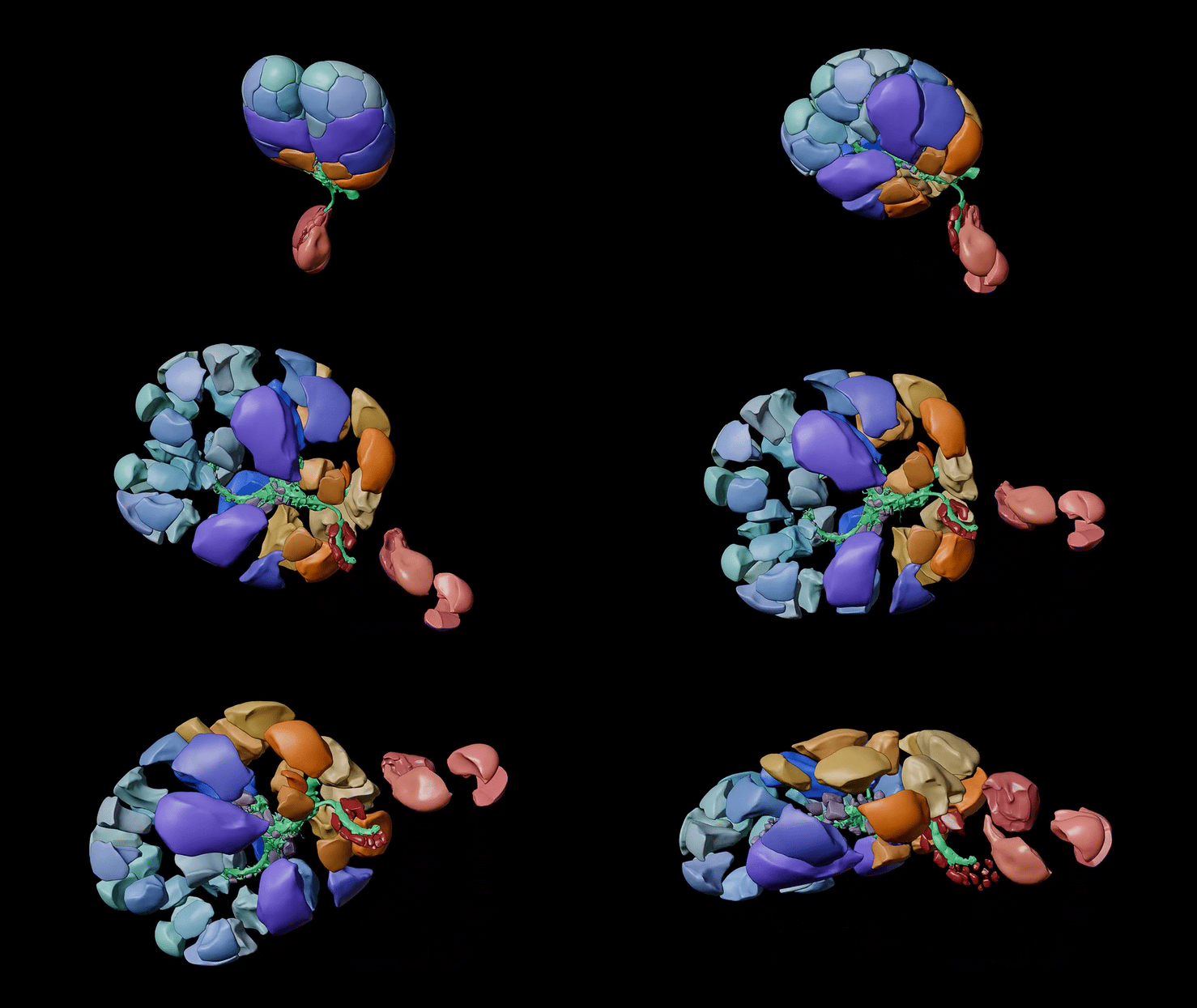
A 3D representation of the aphid's gland that produces BICYCLE proteins
From the start, the proteins presented a problem. Biologists usually identify what an unknown protein does by comparing its amino-acid sequence to the millions already catalogued in public databases; a close match to a known protein is a strong clue to understanding what it does. When looking at the databases, BICYCLE proteins return nothing. They are changing so quickly, generation after generation, that their sequences have been rewritten past the point where those comparisons can recognize any family resemblance.
"We could tell immediately that they didn't look like any other proteins that you might find in a database," Stern said.
That speed is itself a signature of conflict. Proteins that sit at the front line between a parasite and its host tend to evolve fastest, because each side is under constant pressure to counter the other's latest move.
An aphid injecting BICYCLE proteins into a leaf to produce a gall
An aphid's mouthpiece (in red) injecting BICYCLE proteins to form a gall
When AlphaFold gave the wrong answer
Working with the Gronenborn Lab, the team spent years crystallizing two BICYCLE proteins and solving their structures by X-ray diffraction. They matched nothing on record. But they did contain a version of a structural motif seen elsewhere in biology, known as a saposin-like fold.
The same week, a new deep learning tool called AlphaFold2 was released and promised scientists highly accurate protein structure predictions. Stern fed the BICYCLE sequences to AlphaFold2, but it gave them the wrong answer.
Stowers Institute and HHMI Investigator David Stern, Ph.D. conducting fieldwork
That failure became the study's most productive result because it exposed how the AI actually works: AlphaFold2's power does not come from machine learning alone. The program leans heavily on evolutionary data provided to it.
For BICYCLE proteins, that record was missing. "When it searched the database for similar proteins, it couldn't find any," Stern said. "That part of the AlphaFold2 program was empty. It was actually an empty box."
The fix required leaving the computer. The team collected aphids across Virginia and West Virginia, traveled to Japan for one critical species, sequenced their genomes, and handed AlphaFold2 the evolutionary context it had lacked. AlphaFold’s ability to compute what Stern sought was only possible because of what deep learning could gain from evolution itself.
"Lo and behold, AlphaFold2 gave us back the crystal structure that we had solved," Stern said.
A shared blueprint — and an unexpected mystery
With the method working, the team generated roughly 2,400 high-confidence structure predictions across seven aphid species. One clear hint at the architecture kept reappearing: the same saposin-like fold, repeated and rearranged.
The same basic blueprint shows up again and again, but it is duplicated, reoriented, and decorated differently from one protein to the next.
An aphid on a leaf forming a gall
The researchers expected to find something the proteins held in common beyond that foundation: some shared feature hinting at a shared job.
"We didn't find anything," Stern said. "No conserved patches of positive charge or negative charge, or regions that hated water, or regions that really liked water. Nothing."
The proteins clustered by structure but spread into a near-continuous spectrum by surface chemistry. "We used every method we could think of to force them into different clusters, and we just couldn't," Stern said. "That suggests that these proteins are really exploiting many different mechanisms in the plant to take over the plant cell."
The authors propose that BICYCLE proteins are evolving on two fronts at once — reaching new molecular targets inside the plant, and staying unrecognizable to the plant's immune surveillance, forming a highly adaptive arsenal built by an arms race.
"This is really the beginning of our work on the BICYCLE proteins, the beginning of our work on how insects control plants," he said. "I'm very excited about the future and what we're going to be able to do here at Stowers to really understand how these molecules control plant biology."
About the Stowers Institute for Medical Research
Founded in 1994 through the generosity of Jim Stowers, founder of American Century Investments, and his wife, Virginia, the Stowers Institute for Medical Research is a non-profit, biomedical research organization with a focus on foundational research. Its mission is to expand our understanding of the secrets of life and improve life’s quality through innovative approaches to the causes, treatment, and prevention of diseases.
The Institute consists of 25 independent research programs. Of the approximately 500 members, over 370 are scientific staff that include principal investigators, fellows, technology center directors, postdoctoral scientists, graduate students, and technical support staff. Learn more about the Institute at www.stowers.org and about its graduate program at www.stowers.org/gradschool.
Media Contact: Joe Chiodo, Director of Communications 724.462.8529 joe.chiodo@stowers.org