Stowers Investigator tackles a mystery hiding on leaves — and the proteins behind it
After more than a decade at HHMI's Janelia Research Campus, David Stern, Ph.D., moved his research program to the Stowers Institute. He arrived in early February and is now exploring how sap-feeding insects steer plant growth, the role of newly discovered proteins, and potential paths to next-gen pest control.
27 February 2026
A poet's approach to science
“I like to think that scientists are actually very similar to poets. We look very closely at nature and report back on what we saw.”
That’s how the Stowers Institute's newest Investigator, David Stern, Ph.D., a developmental and environmental biologist and Howard Hughes Medical Institute (HHMI) Investigator, frames his research.
“It’s what the best poets do, and what the best science always does.” It’s fitting, because the kinds of questions he’s bringing to the Institute often start with noticing things most people miss.
Stern’s team recently made a discovery that began with that kind of attention: an entirely new family of proteins that aphids—tiny sap-feeding insects—inject into plants. “They don’t look like any proteins that we know about,” he said.
His lab calls them “BICYCLE proteins.” When they first examined the sequences, they couldn’t tell what they were related to. So they solved the three-dimensional structure. And even then, Stern said, the proteins still didn’t resemble anything familiar.
Why are they called BICYCLE Proteins? Listen to Stern explain.
What comes next
That’s why Stern’s next chapter isn’t just about what was found, it’s about figuring out what this family of proteins does. “Now we’re doing cell biology…” he said. “Now we’re doing genetics…"
His team hopes to uncover exactly howthe BICYCLE proteins contribute to the plant. After 15 years at HHMI Janelia, Stern arrived at the Institute in early February, bringing his lab to Kansas City—and a determination to see this project through.
“Some people would say, maybe I should be thinking about retirement,” he said. “But I feel like a graduate student all over again—and Stowers is one of the few places on earth that embraces that vision. All I want to do is scale up this project and answer these questions.”
The work now moves from tracking where these proteins end up inside plant cells to knocking out aphid genes and testing their actual functions. But it's not a simple problem to solve. Stern is blunt about what that feels like.
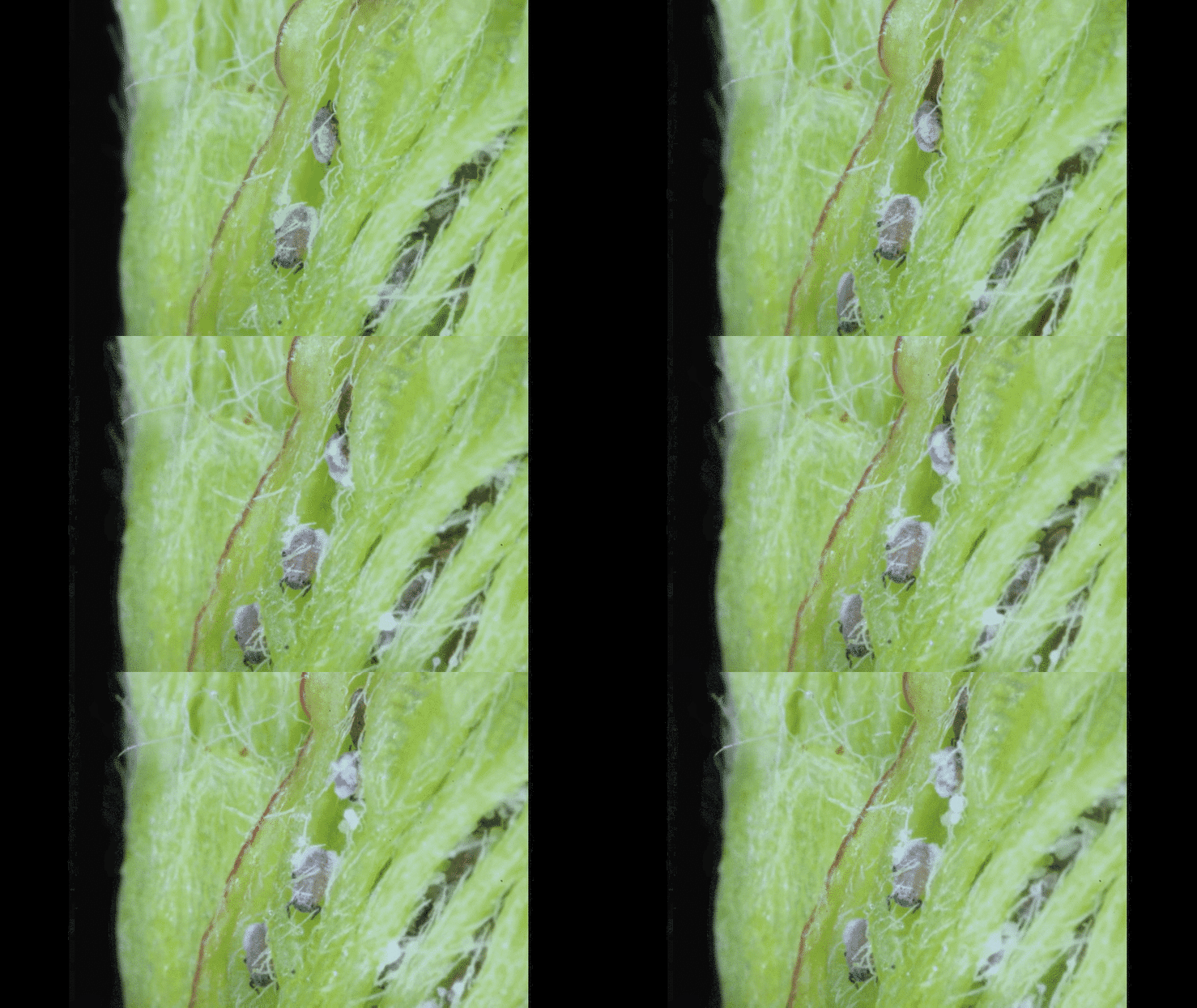
Aphids on leaf
“None of this is easy,” he said. “Discovering really new stuff in biology is not easy.” Sometimes, he added, the latest and greatest technology "does nothing." Sometimes what you need is old-fashioned.
“My favorite old-fashioned technique is genetics,” he said. “There’s just nothing as powerful as genetics.” He describes pairing modern sequencing with foundational experiments that go back nearly 200 years, combining new tools with classic logic.
Hiding in plain sight
In any forest around the world, if you open your eyes, look closely, or, as Stern would say, "think like a poet," you will find the exact subject of his research.
Gall pictured on leaf
"It's called a gall," he said. "Look at what's happening on the leaves or on the stems of plants anywhere, and you'll see them."
When the aphids inject proteins into the plant, they completely transform the plant's tissue. This creates the gall, or a "home", that they live within. “They're ubiquitous...all over the world...but we know almost nothing about how the insects are controlling the plants," Stern added.
“So, we can see what this entirely new family of proteins look like — but we still don’t know how they operate or why.
3D-rotated view of galls
His team's next move, he said, is “to understand how they’re interacting with their target molecules.”
“We’re currently trying to see where these proteins go in the cell,” he said. “We do actually know where they’re going in the plant, and that gives us some understanding of what they’re doing.”
Why it could matter for food and crops
Beyond solving a mystery, the work has a significant potential impacts on human health. “We take for granted that food appears in the grocery store…and we don’t really think very often about, well, 'how did this get here?'” he said.
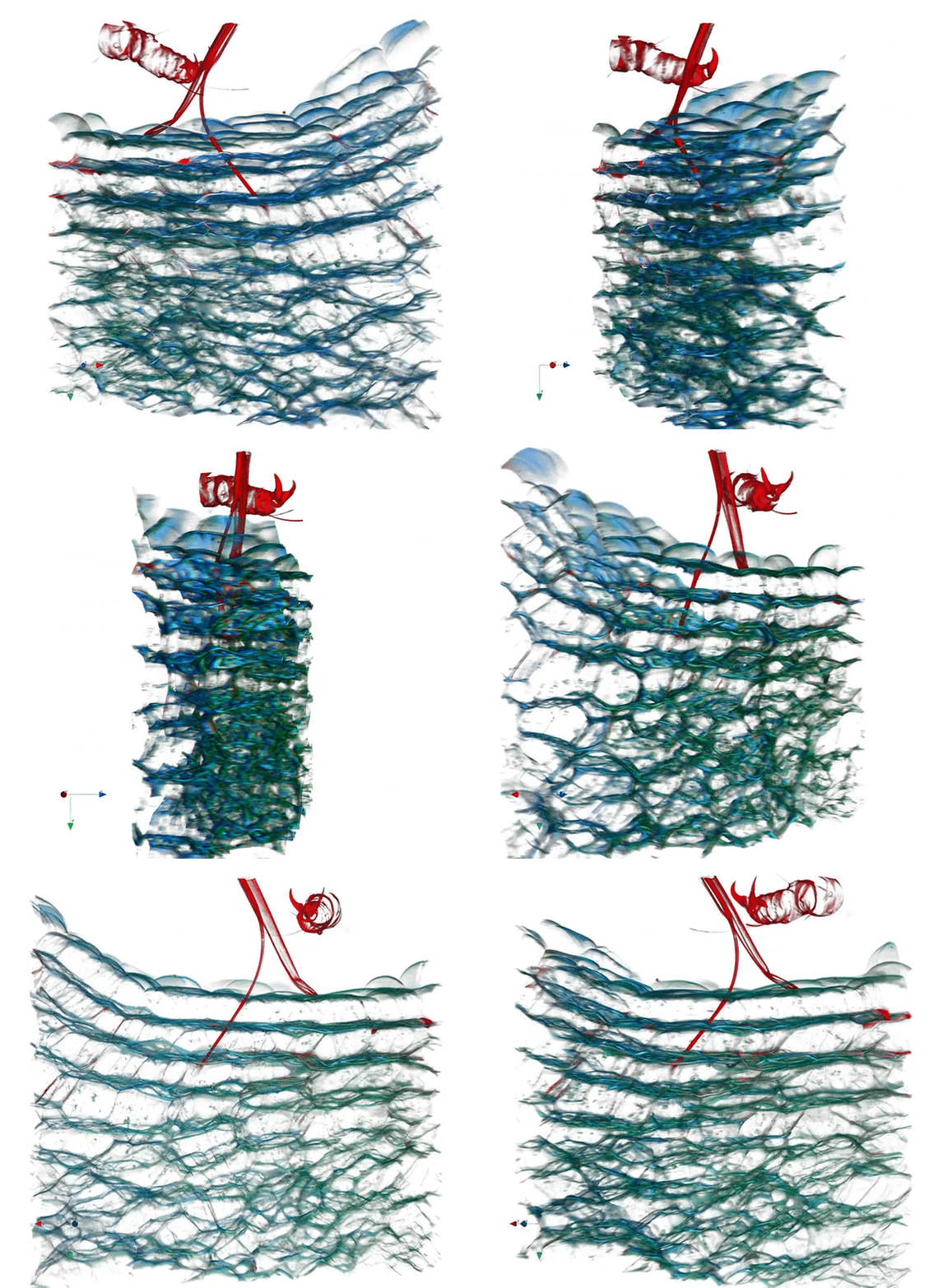
Microscope view of an aphid stylet (red) threading through plant tissue—an essential tool sap-feeding insects use to reach their food source.
Much of modern agriculture depends on preventing crops from being eaten by pests, especially insects.
Not all pests are equally controllable. Some insects, like caterpillars, chew leaves. In those cases, pesticides on the leaf surface can work. But sap-sucking insects are different. They’re “highly specialized predators of plants,” Stern said, able to thread their mouthparts through plant tissue to feed in ways that can help them avoid many of the usual preventative measures we typically rely on.
That’s part of why Stern is confident about the potential. “Our lab has also discovered that these proteins are essential for aphid survival,” he said. Because the proteins are produced in salivary glands and injected into plants, those glands may be an “Achilles’ heel for sap-sucking crop pests worldwide.”
A 3D microscopy image of an aphid inside a plant gall—an unusual growth the insect triggers as it manipulates plant tissue.
Aphids are sometimes called the “mosquitoes of the plant world.” They don’t just feed on plants, they also spread disease. Stern said the findings may “open the door to next generation pest control strategies that are precise, effective, and safe.”
A new office...in the lab
Stern sees his new home at the Stowers Institute as the right next step, noting it's one of "few places on earth" built to support "true, curiosity-driven research."
And he’s clear about where he wants to do that research: “My office is the lab,” Stern said. “I love pipetting. I love running gels. I love doing experiments…and I’m happiest when I’m with my people doing science.”
In fact, that's how this whole project began. "I started it with my own hands, on the side," Stern recalled. "It's a problem I was just always fascinated by for decades, so I just started doing experiments."
Along the way, people in his lab joined him. Eventually, it led them to the field, taking a poet's approach to look closely at what others may have missed—and then return to the lab to report what they found.
Now, it's ultimately led him here.
"Even from an early age, one of my favorite hobbies was going and getting lost in the woods," he said. "So yeah, these habits, they're pretty deep in my soul."