Press Release
17 March 2025
Stowers scientists uncover principles underlying the toxicity of “selfish” genes
The findings may help scientists better understand infertility, neurodegeneration, and evolution.
Read Article
What if...?
The first story in the Stowers Institute’s new ‘What if?’ campaign follows Associate Investigator Randal Halfmann, PhD, in his search to understand aging and how nature may hold clues to healthier, longer lives.
Explore the Stowers Intitute's full What if? series here.
Randal Halfmann, Ph.D., grew up on a remote ranch in West Texas and spent much of his childhood outdoors. Fascinated by rocks, he became especially captivated by crystals and the way matter naturally forms patterns, developing into something beautiful and yet utterly predictable. It was a fascination that he never outgrew.
Today, Halfmann is an Associate Investigator at the Stowers Institute, and that childhood wonder still shapes his work.

Randal Halfmann, Ph.D., as a child in West Texas
"What if we don't have to age? What if we don't have to get sick when we get old?" he asks. For Halfmann, that question drives his research.
"I study crystallization, but in a different way," he said. "I look at how proteins in the body can self-organize in incredibly complex yet predictable ways." The ten-year-old peering at rocks and crystals on the Texas plains had no idea he was laying the foundation for a career in molecular biology.
Halfmann's scientific journey took off while earning his undergrad at Texas A&M University, when he encountered the concept of protein folding. He was drawn to the puzzle of how a one-dimensional string of amino acids folds into a precise three-dimensional structure. In graduate school at the Massachusetts Institute of Technology, he learned of the fourth dimension in protein folding: time. Proteins change, accumulate, and aggregate as organisms age. The central question of his career took shape: What if we understood how a protein's sequence determines not just its shape, but its future?
At MIT, Halfmann also encountered prions — a type of infectious agent made only of protein. At the time, they were notorious for causing diseases like mad cow. He learned, however, that protein aggregation isn't always destructive. Sometimes it's essential. This revelation became the foundation of his lab's work.

Stowers Institute Associate Investigator Randal Halfmann, Ph.D.
Today, Halfmann's research sits at the intersection of immunity and aging. His lab has found that certain proteins must aggregate for the body to defend itself against viruses and bacteria, but that same capacity appears to drive aging. "A trade-off is emerging from our work: We seem to need proteins to aggregate in order to have immunity. But there's a cost," he says. His team is now studying the proteins of organisms that appear immune to aging, hoping to understand how they've decoupled these two forces.
“What if people knew when they were going to die?” Halfmann said.
He envisions a future where protein aggregation patterns in a patient's sample could predict the onset of Alzheimer's, Parkinson's, Huntington's, or ALS decades in advance.

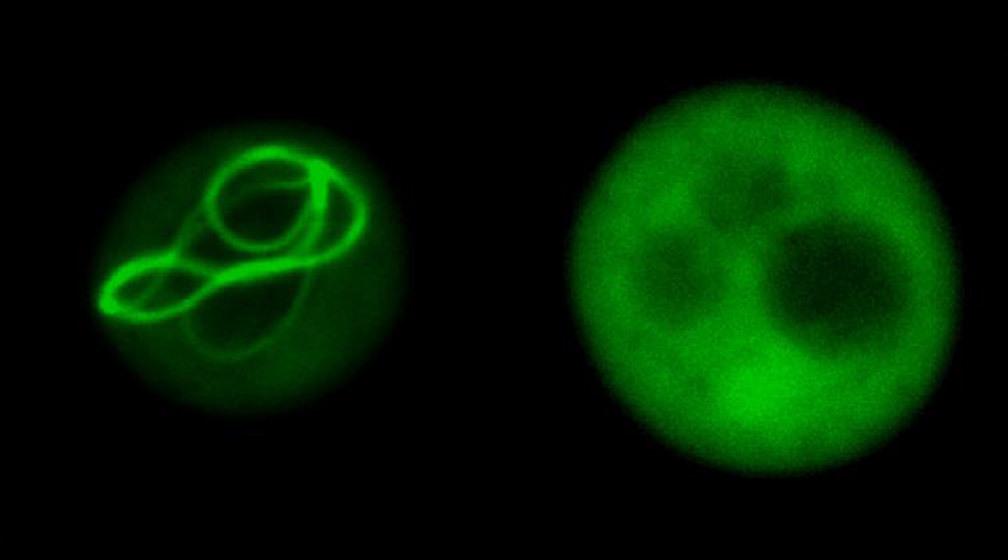
Prion-like polymerization of a human signaling protein in a budding yeast cell.
“That knowledge could buy you time, whether to enroll in a clinical trial or simply prepare,” he explained. "And it buys me time to understand the process and potentially figure out how to stop it.”
It's what motivates Halfmann to return to the lab each day, working to better understand the mysteries of life — and death — in ways we haven’t before.
“I think it's helpful for people to know there are scientists asking, what if?” he said, “motivated by a belief that there is an alternative outcome. That belief is what keeps me going.”
What if? is a series following Stowers Institute investigators as they explore the thrills and challenges of scientific discovery. Read more
Press Release
17 March 2025
The findings may help scientists better understand infertility, neurodegeneration, and evolution.
Read Article
News
23 May 2024
Though presently incurable, research from Stowers Associate Investigator Randal Halfmann, Ph.D., is helping improve our understanding of how the ALS amyloid protein that forms aggregates in the brain first starts. Recently, the team made an unexpected, exciting discovery that offers hope for the future.
Read Article
Press Release
13 June 2023
Stowers scientists deduce the initiating structure of the amyloid implicated in Huntington’s and present a potential therapeutic treatment approach.
Read Article