For Stowers Graduate School alum Steffi Williams, Ph.D., teaching will always be a central part of her scientific future thanks to early opportunities to lead in the classroom.
12 March 2026
When Steffi Williams, Ph.D., first delivered a lecture on genetics, she admits she was nervous. “The idea of preparing a lecture of my own was very intimidating at first,” she said, “but I learned how to crystallize the most important things of a given topic and convey them to a room full of students.”
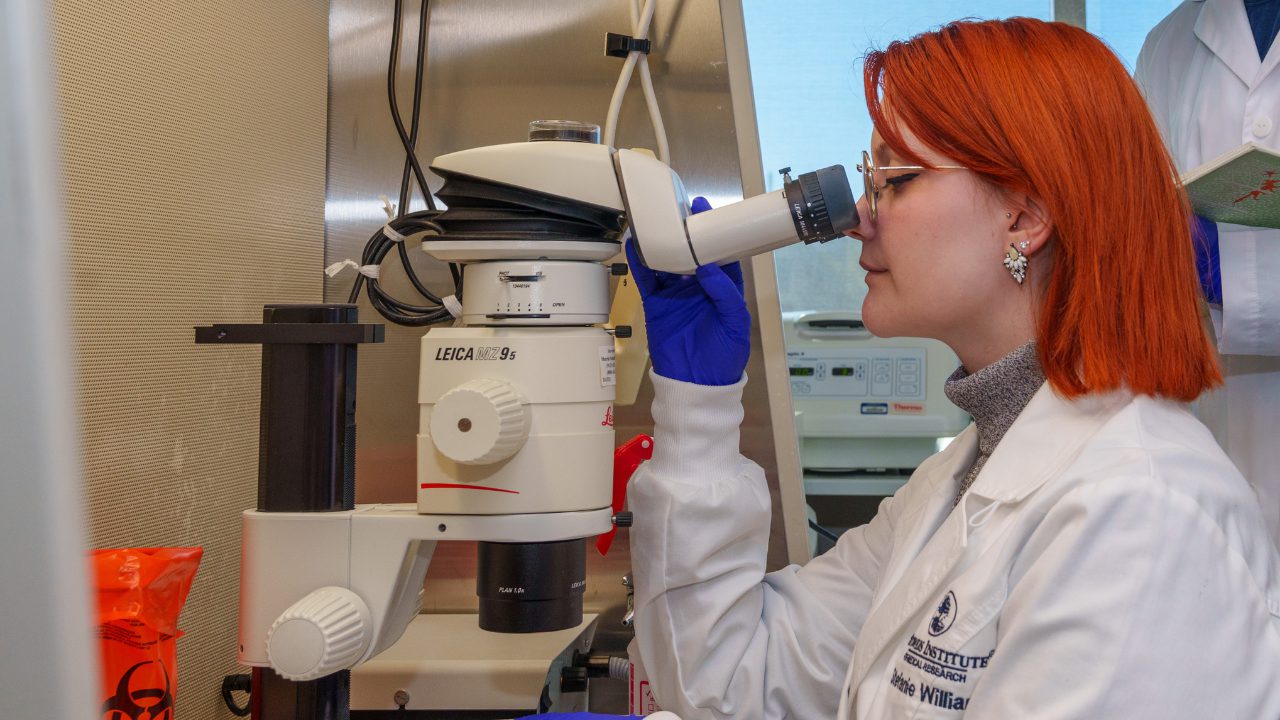
Williams, a Stowers Graduate School alum and current postdoctoral fellow at the European Molecular Biology Laboratory in Germany, studies meiosis, the specialized cell division that makes eggs and sperm. This process is critical for successful reproduction — disruptions in meiosis can result in the wrong number of chromosomes. For example, inheriting three copies of chromosome 21 is the genetic hallmark for Down syndrome.
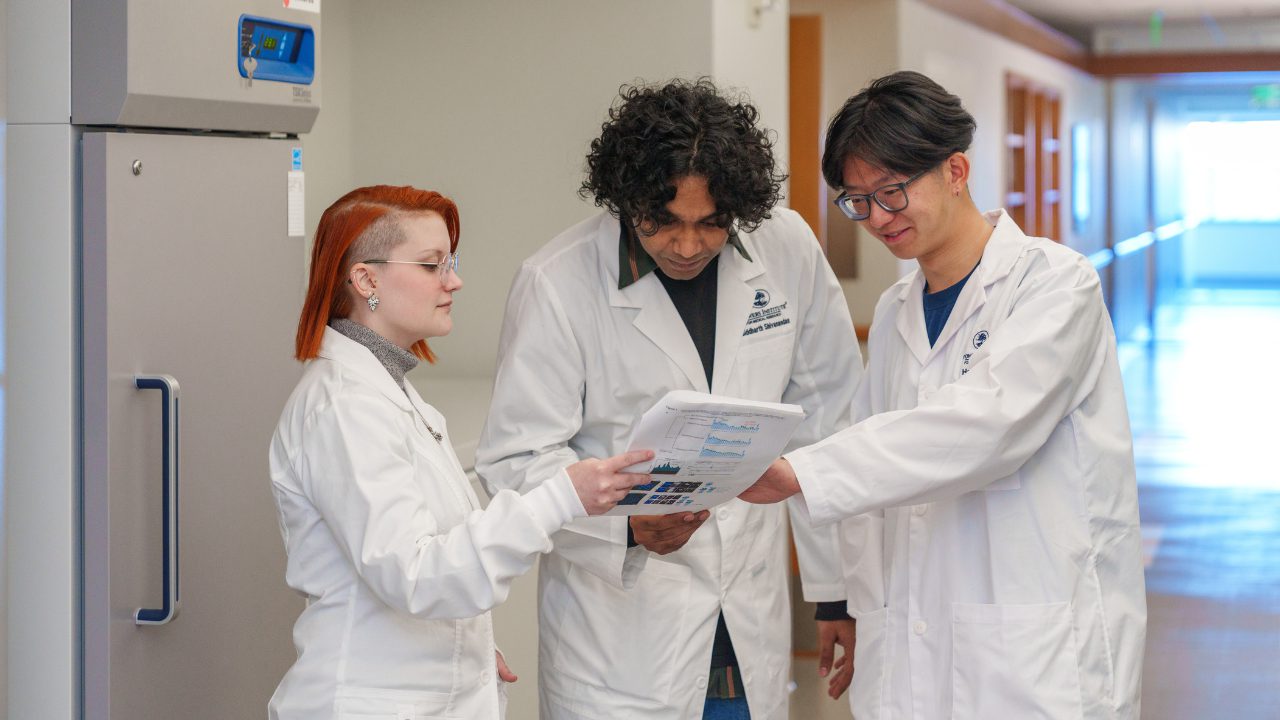
Steffi Williams, Ph.D., and Stowers Graduate School student Haining Jiang
Inspired by the passion of her Ph.D. co-advisor, the late Stowers Investigator Scott Hawley, Ph.D., Williams spent the spring 2024 semester serving as a teaching assistant for the "Advanced Genetic Analysis" course at the University of Missouri-Kansas City (UMKC), whose campus is right across the street from the Stowers campus. The role went far beyond grading papers. Williams attended every session, designed exam questions, and ultimately stepped up onto the podium to deliver three original lectures to undergraduate students.
The first part of Williams’ graduate work focused on the genetics underlying meiosis in fruit flies. She then transitioned to studying this process in the sea anemone Nematostella vectensis, a far more ancient ancestor. In the lab of Investigator and Graduate School President Matt Gibson, Ph.D., her goal was to establish Nematostella as a powerful model for a comprehensive understanding and an evolutionary framework of the complex genetics governing sexual reproduction.
The synaptonemal complex, which is a multi-protein structure that forms in early meiosis between the maternal and paternal copy of each chromosome. Here, we see two such structures in the fruit fly. Image taken by Steffi Williams
Reflecting on her time in the classroom, Williams shared, “My aim was to convey to students a deeper understanding of the complexities of genetics. While oftentimes, genes are used to provide simple answers to tough topics, they can’t explain everything. At the same time, how they work is fun to study.”
For Williams, teaching isn’t a side project; it is a part of becoming the kind of scientist she hopes to be. She explained that these experiences of having to communicate “niche research topics” to non-experts are the same skill that lets her connect a sea anemone’s reproductive biology to big human questions about how cells faithfully pass on chromosomes.
Steffi Williams, Ph.D., and Stowers Graduate School student Haining Jiang
“As I am working towards becoming a professor, teaching will most likely be one of the most important parts of my future,” Williams said. “Collecting these experiences early in my career gave me the confidence to know that I truly enjoy this part of the job.”
Learn more about the Stowers Graduate School and the education and outreach opportunities available to students.