

News

25 August 2026
A Summer of Discovery
Reflecting on the 2026 Stowers Summer Scholars Program
Read Article
News

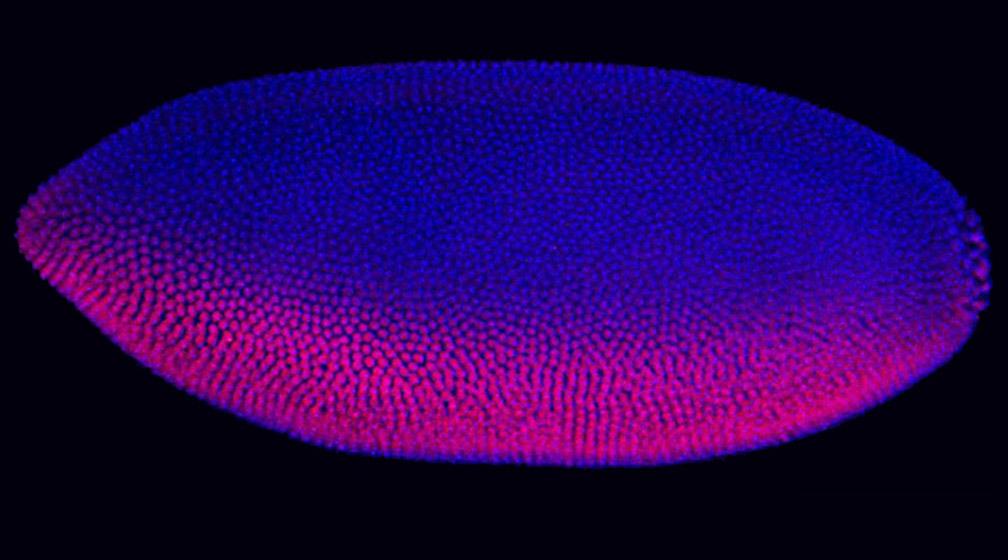
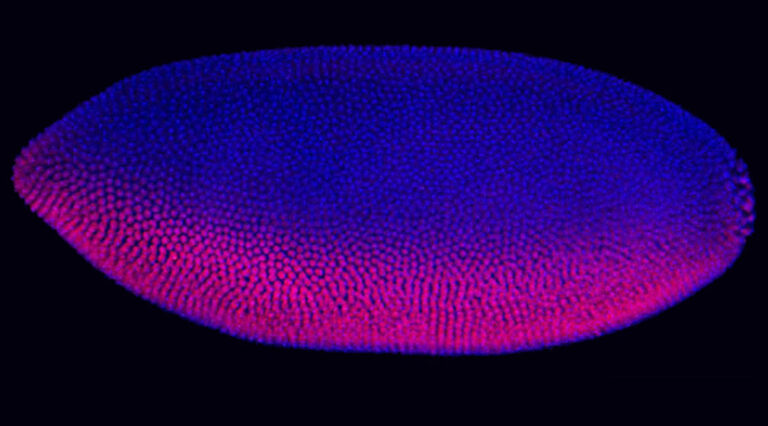
A key transcription factor involved in embryonic patterning called Dorsal forms a gradient (magenta fluorescence) along the dorsoventral (back-belly) axis in an early stage fruit fly embryo. Image courtesy of Kaelan Brennan.
Kaelan Brennan, a predoctoral researcher in the Graduate School of the Stowers Institute for Medical Research, has received fellowship funding to explore how genes become active at appropriate times and locations during development. Brennan will focus on how DNA elements called enhancers control gene expression during embryonic development of the fruit fly Drosophila melanogaster.

Kaelan Brennan
Enhancers are regulatory sequences contained in DNA that underlie a wide variety of human diseases when misregulated because they determine when and where a target gene will be expressed. Because these sequences are critical for driving proper gene expression during development and cellular transitions, they are maintained in an inaccessible and inactive state until the precise context for gene activation is reached.
Brennan, who is predoctoral researcher in the Zeitlinger Lab, aims to show how enhancers are made accessible and active by DNA-binding proteins called transcription factors during fruit fly development, which will provide insight into the mechanisms used by cells to regulate enhancer activity to control their gene expression programs. Because mechanisms of regulating gene expression are often used in similar ways by species across the animal kingdom, the identification of rules for gene regulation helps researchers gain a better understanding of regulation of the human genome in development and disease.
Funding of the fellowship comes from the Eunice Kennedy Shriver National Institute of Child Health and Human Development which is part of the National Institutes of Health.
News

25 August 2026
Reflecting on the 2026 Stowers Summer Scholars Program
Read Article
Press Release

25 August 2026
A team from the Zeitlinger Lab developed PISA, a new method for visualizing what deep-learning models learn from DNA at single-base resolution. By separating experimental bias from biological signal, the team was able to train a more focused model that revealed previously hidden DNA sequence features linked to nucleosome positioning and the genome’s larger three-dimensional organization. The work also shows how model interpretation can guide new experiments and help biologists move from AI prediction toward biological mechanism.
Read Article
News

21 August 2026
Postdoc Profile: Anna Klompen, Ph.D., on her Stowers research experience — "My experience at the Institute has been exceptional."
Read Article