News
13 December 2023
The Great Planarian Hunt
“For any complex question, we always need to go back to nature and ask, can we find the right organism that may provide an answer?”
Read Article
News
New single-cell atlas of the acorn worm shows that most tissues undergo a genome-wide transcriptional overhaul as larva becomes adult, providing new insights into how some organisms remake their bodies in ways humans can’t.


Stowers Institute President and Chief Scientific Officer Alejandro Sánchez Alvarado, Ph.D., a co-author of the study
Many animals live two lives. A caterpillar becomes a butterfly. A swimming, transparent larva drifting in the open ocean becomes a worm that spends its life burrowing in mud. Biologists have long understood what happens to the body during this transformation. What happens to the individual cells has been far harder to see.
New research from the Stowers Institute for Medical Research and Stanford University's Hopkins Marine Station, published in Nature Communications on September 8, 2026, now offers one explanation, focusing on the marine acorn worm, Schizocardium californicum. Using single-cell RNA sequencing to profile the whole animal at five points across its life cycle, the team found that larval and adult cells occupy strikingly different molecular states — and that the adult is built not by discarding the larva's cells, but by rewriting them.
“What is remarkable is that this animal does not simply grow from one form into a larger version of itself,” said Stowers Institute President and Chief Scientific Officer Alejandro Sánchez Alvarado, Ph.D., a co-author of the study who helped design and supervise the investigation. “It constructs one body for life in the water and then transforms it into another for life on the seafloor.”
Most of what science knows about animal development comes from a handful of research organisms — fruit flies, mice, zebrafish — that build their adult body plan early, during embryogenesis. But a large share of animal life does not work that way. In indirect developers, the adult emerges weeks or months later through metamorphosis, from a larva with its own distinct anatomy, ecology, and behavior. How that second body plan is assembled at the level of cells has remained largely uncharted.


Indirect developing hemichordates as a model to study the transition between larval and adult body plans.
The acorn worm is well suited to the question. It is a hemichordate, the sister group to sea stars and sea urchins, and it occupies a key position for helping scientists understand how animal body plans evolved. Its metamorphosis is dramatic. The larva swims in the plankton, sweeping up food with bands of beating hairs. What emerges is a worm that lives buried in seafloor mud, with a muscular snout for digging, slits in its throat for straining food from water, and cords of nerves running the length of its body.
“To see that change at single-cell resolution gives us an entirely new way to ask how stable, or how flexible, a cell’s identity truly is,” Sánchez Alvarado added.
The team sequenced 87,021 individual cells across early larva, late larva, metamorphosis, early juvenile, and late juvenile stages, sorting them into 56 clusters and 12 broad cell classes — including cartilage, muscle, immune, neural, and several previously undescribed populations. They built a comprehensive atlas of the animal’s cell types and uncovered a surprising pattern in how those cells change over time.


Christopher Lowe, Ph.D., a Professor at Stanford's Hopkins Marine Station and lead author on the study
"Pretty much everything we understand about how cells commit to a fate comes from a handful of species that develop straight from embryo to adult, and in those animals it looks like a one-way trip," said Christopher Lowe, Ph.D., a Professor at Stanford's Hopkins Marine Station and lead author on the study. "This animal isn't doing that. We can see larval cells still there in the juvenile after metamorphosis, so a lot of what the adult is made of appears to be old cells doing something new."
A surprising pattern
Stowers Institute researcher Carolyn Brewster and former Stowers postdoctoral associate Blair Benham-Pyle, Ph.D., now an assistant professor at Baylor College of Medicine, contributed to the study alongside Sánchez Alvarado.


Former Stowers postdoctoral associate Blair Benham-Pyle, Ph.D., now an assistant professor at Baylor College of Medicine
The team found many cells grouped more strongly according to whether they came from a larva or juvenile than according to their tissue type — showing life stage was a major organizing feature of cellular identity.
“When we first started analyzing the data, we expected a neuron to look most like another neuron and a gut cell to look most like another gut cell, regardless of life stage,” Benham-Pyle said. “Instead, for many tissues, larval cells shared more traits with other larval cells than they did their juvenile counterparts. I think that really reframes the question. The animal is not just rearranging the same pieces into a new body plan. The cells themselves may be changing in much more fundamental ways than we anticipated.”
One tissue breaks the pattern
Muscle and connective tissue were the clear exceptions. Unlike skin, gut and nerve cells, mesodermal derivatives – including muscle – retained a stable transcriptional profile across the larval-to-adult transition. That split suggests the worm relies on at least two distinct developmental strategies simultaneously: a wholesale transcriptional reprogramming for the ectoderm- and endoderm-derived tissues, paired with a steady continuity in the mesoderm.

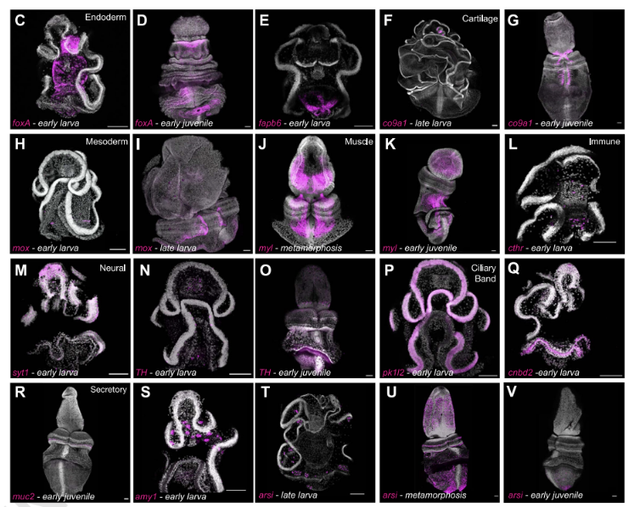
Single-cell sequencing reveals the broad diversity of hemichordate cell types.
Cells persist. They don’t get replaced.
That raised an obvious question: Are the larval cells simply dying and being replaced by adult cells built from reserve stem cells? To test it, the researchers labeled dividing larval cells and then tracked them for weeks. Labeled cells were still present in the juvenile worm — in the proboscis, the collar, and the dorsal nerve cord — and some had switched on genes characteristic of adult neurons. The larval cells were not thrown away. They were repurposed. The cells themselves endured; it was their transcriptional states that were rewritten. In this animal, cellular identity appears to be less something a cell is than something a cell does.
A genome-wide phenomenon, not a few master switches
The team also found that the divergence between larval and adult states is not driven by a small set of master control genes. Removing the most differentially expressed genes from each functional category barely changed the picture. The difference is broad and distributed, spread across regulatory, metabolic, and physiological programs — consistent with cells being wholly retuned for the different demands of drifting in open water versus burrowing in sediment.
The findings carry a practical caution for the growing effort to catalog every cell type in the animal kingdom. Most cell atlases sample a single life stage. This work suggests that an atlas built from a larva may describe a genuinely different cellular landscape than one built from the adult of the same species.
“If we can understand how an animal changes the identity and function of existing cells as it builds a new body, we may begin to uncover principles that help explain why that flexibility is so limited in us,” Sánchez Alvarado said. “Those principles are essential if we ultimately want to learn how to restore tissues that have been damaged by injury or aging.”
New organism, familiar question
"Stowers has been making the argument for years that the good biology is often sitting in animals nobody has bothered to domesticate, and that cell identity is a lot more flexible than the textbooks let on," Lowe said. "That's the right mindset for a result like this. We spent a long time trying to talk ourselves out of it."
The evidence that finally persuaded them was gathered the hard way, in the mudflats of Morro Bay. For this collaboration, Lowe’s group worked to collect the worms from the Morro Bay mudflat, keep them alive, and carry them through the metamorphosis that this study was built upon.
For Sánchez Alvarado, the study represents a new field of exploration for his lab, which has long focused on the regenerative capabilities of planarian flatworms. Planarians can grow back entire bodies following injury, making them a powerful system for studying stem cells, regeneration and cellular plasticity.
The acorn worm presents those same fundamental questions in a different setting. Rather than rebuilding, it naturally transforms one functional body into another during its life cycle. Studying that transition allowed the team to ask how flexible cellular identity can be when change is built into an animal’s normal development. In that sense, metamorphosis offers a naturally evolved counterpart to the transient cell states the laboratory has described in regenerating planarians. In both cases, existing cells are licensed to adopt new states in order to build, or rebuild, a functional body.


Planarian flatworms
“One reason progress can be difficult is that the organisms we have traditionally selected for research may not display the biology we are trying to understand,” Sánchez Alvarado said. “Nature has already produced remarkable solutions. When we make a new organism accessible to experimentation, we open doors to questions that were previously very difficult to ask.”
"If you look at the cells, the larva and the adult of the same species are almost two different animals," Lowe said. "Most animals have a life cycle like this. It's not an oddity, and I don't think we can write a general story about how cell types evolve without integrating data from this type of animal."
This research brought together scientists from the Stowers Institute, Stanford University, Baylor College of Medicine, Chan Zuckerberg Biohub, the University of California, Berkeley, Pomona College, the National Institutes of Health, Johns Hopkins University and the Okinawa Institute of Science and Technology.
News
13 December 2023
“For any complex question, we always need to go back to nature and ask, can we find the right organism that may provide an answer?”
Read Article
News
13 December 2023
Planarian flatworms could unlock the secrets to how we may—someday in the future—regrow a damaged or missing limb or repair an organ, potentially transforming the lives of the generations to come.
Read Article
News
06 February 2026
The new study reveals miniature “packages” help planarian cells share gene-silencing instructions across the body.
Read Article
In The News


22 February 2023
From the Vilcek Foundation, Alejandro Sánchez Alvarado is the executive director and chief scientific officer of the Stowers Institute. A molecular and developmental biologist, his work focuses on the molecular, genetic, and cellular processes of regeneration in living organisms.
Read Article