News


10 March 2026
A postdoc's quest to help sensory cells grow back
Postdoc Profile: Raman Kaushik joined the Piotrowski Lab to explore why zebrafish regenerate hair cells so well, and why mammals struggle.
Read Article
The primary focus of our lab is understanding the development and regeneration of the zebrafish lateral line and the potential applications for promoting mammalian hair cell regeneration to restore hearing loss or deafness.
Jump to:
Publications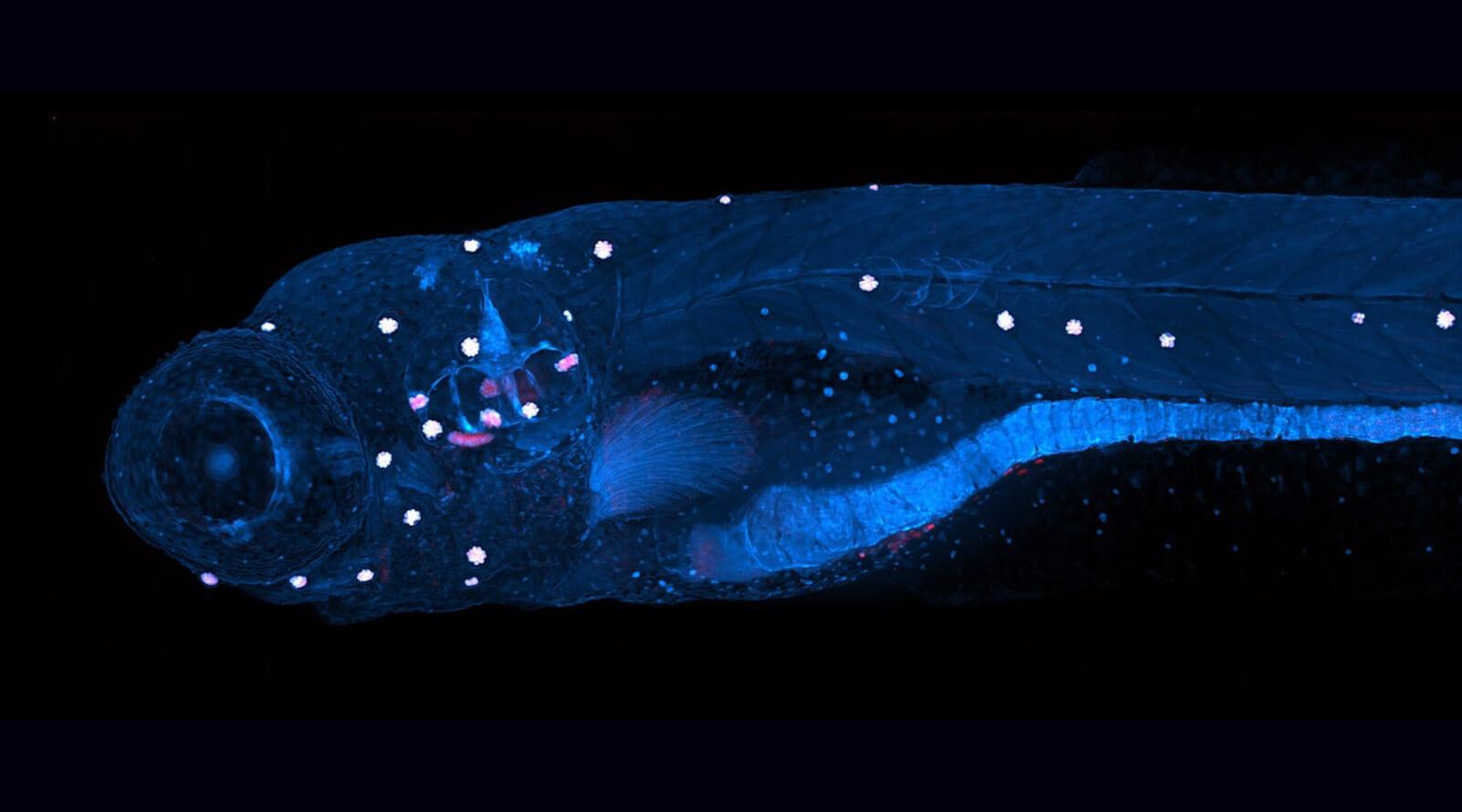

Research Summary
Development and Regeneration, Evolutionary Biology, Molecular and Cell Biology
Zebrafish, Cavefish
The Piotrowski Lab focuses on development and regeneration of the lateral line sensory system in zebrafish. Research into this system offers growing insight into human sensory organ development and disease, including why individuals lose their hearing as they age.
The lateral line develops from a group of around 100 cells, the primordium, which forms behind the fish's ear, migrates toward the tail tip, and deposits sensory organs, called neuromasts, along the way. Hair cells within neuromasts extend cilia, which look like tiny hairs, to detect water movement, enabling fish to orient themselves, find prey, and avoid predators in the water. These hair cells are remarkably similar to those in mammalian ears that detect sound waves and enable hearing.
The Piotrowski Lab’s research has developed the lateral line system into a powerful model and has identified several genes required for the coordinated migration of groups of cells and uncovered how signaling pathways interact to subdivide the primordium into leading and trailing regions. This aids our understanding of cancer biology, as several human cancers invade tissues as groups of cells.
The Piotrowski Lab investigates how zebrafish sensory hair cells develop and regenerate after injury. In mammals, once hair cells die from aging or after prolonged noise exposure, their inability to regenerate results in permanent hearing loss, in contrast to species who continually generate new hair cells. The team is hopeful their research will elucidate how zebrafish hair cells regenerate to provide clues for triggering hair cell regeneration in mammals, paving the way for treatments for hearing loss.
Principal Investigator
Investigator
Stowers Institute for Medical Research
Tatjana Piotrowski, Ph.D., a developmental biologist, is an Investigator at the Stowers Institute. She joined Stowers in 2011 as an Associate Investigator and was promoted to full Investigator in 2018.


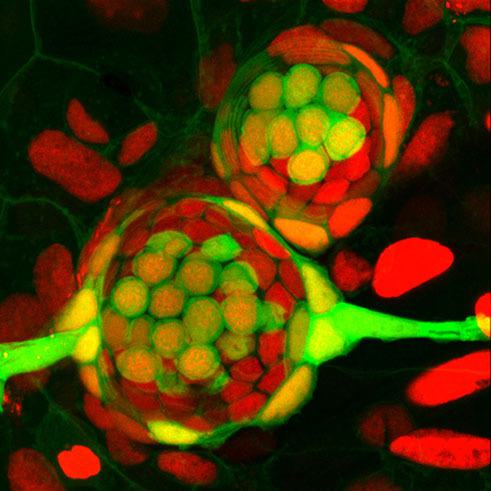
The Piotrowski Lab has been performing single-cell expression analyses of regenerating sensory organs to determine which genes are activated or silenced in each cell. They are currently testing the function of these genes and how they are transcriptionally regulated.
Why should an early career scientist choose Stowers? Investigator Tatjana Piotrowski says the Institute provides unparalleled mentorship that helps ensure success for new faculty.
News
10 March 2026
Postdoc Profile: Raman Kaushik joined the Piotrowski Lab to explore why zebrafish regenerate hair cells so well, and why mammals struggle.
Read Article
News
03 March 2026
These tiny sensory cells offer big implications for human health. Learn the biological basics of hair cells, how they allow us to hear and balance, and what makes zebrafish so important for regeneration research.
Read Article
News


03 March 2026
How do our ears allow us to hear? How does music become part of our memory? Here are three ways Stowers science is revealing the mysteries and mechanisms of hearing.
Read Article
prdm1a drives a fate switch between hair cells of different mechanosensory organs
Sandler JE, Tsai YY, Chen S, Sabin L, Lush ME, Sur A, Ellis E, Tran NTT, Cook M, Scott AR, Kniss JS, Farrell JA, Piotrowski T. Nat Commun. 2025;16:7662 doi: 10.1038/s41467-025-62942-0.
Paired and solitary ionocytes in the zebrafish olfactory epithelium
Peloggia J, Cheung KY, Petkova MD, Schalek R, Boulanger-Weill J, Wu Y, Wang S, van Hateren NJ, Januszewski M, Jain V, Lichtman JW, Engert F, Piotrowski T, Whitfield TT, Jesuthasan S. Chem Senses. 2025;50:bjaf031.
Lush ME, Tsai YY, Chen S, Munch D, Peloggia J, Sandler JE, Piotrowski T. Nat Commun. 2025;16:5913 doi: 10.1038/s41467-025-60251-0.
Real-time imaging reveals a role for macrophage protrusive motility in melanoma invasion
Ramakrishnan G, Miskolci V, Hunter M, Giese MA, Munch D, Hou Y, Eliceiri KW, Lasarev MR, White RM, Huttenlocher A. J Cell Biol. 2025;224:e202403096.
Environmental and molecular control of tissue-specific ionocyte differentiation in zebrafish
Denans N, Tran NTT, Swall ME, Diaz DC, Blanck J, Piotrowski T. Nat Commun. 2022;13:5356 doi: 10.1038/s41467-022-33015-3.