News

11 April 2026
What is the spark that lights the fire?
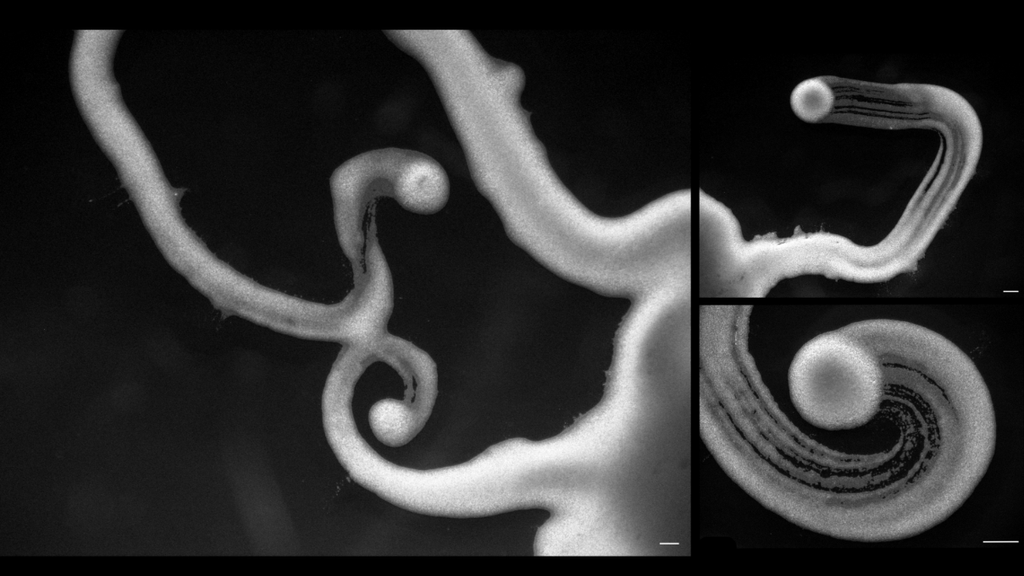
Neurodegenerative diseases like Parkinson’s often begin small and then rapidly spread like wildfire. The Halfmann Lab is uncovering the places where disease begins.
Read Article
News
Promoted to Investigator, Randal Halfmann, Ph.D., has built a research program around the molecular events that help cells adapt, defend themselves, and sometimes begin a path toward disease — and there are plenty of questions he still wants to ask.
When a protein changes shape, it may begin with a single molecule and last only an instant. But once it happens, other proteins can follow. A new structure begins to grow and from there, a cell changes course.
That chain reaction can help an organism adapt, amplify an immune response, or destroy an infected cell. It can also begin the protein aggregation associated with Parkinson’s, Alzheimer’s or Huntington’s disease, ALS, inflammation, and other age-related conditions.
Understanding this molecular point of no return is the pursuit of Randal Halfmann, Ph.D. Halfmann was promoted and renewed this year from Associate Investigator to Investigator at the Stowers Institute for Medical Research, after evaluation by the Institute’s Scientific Advisory Board.
Since joining the Stowers Institute in 2015, Halfmann and his team have developed new ways to observe how proteins self-assemble inside living cells, connecting areas of biology that might otherwise seem unrelated.
"How do proteins dictate how an organism changes over time?” Halfmann said.
His work has shown that aggregation is not simply a sign that something has gone wrong. It is a driving force that biology uses for both beneficial and harmful purposes.


Investigator Randal Halfmann, Ph.D., collaborates with a researcher in the lab.
Following curiosity, from MIT to KC
Halfmann’s fascination with proteins began as an undergraduate at Texas A&M University, when he encountered one of biology’s enduring puzzles: how a one-dimensional string of amino acids folds itself into a precise three-dimensional structure.
While pursuing his doctorate at the Massachusetts Institute of Technology, he became interested in another dimension of the problem: time. And how a protein’s structure can change over the life of a cell.
In the lab of Susan Lindquist, Ph.D., Halfmann studied prions, which are proteins capable of adopting self-perpetuating structures that can be passed from one generation of cells to the next. Prions were best known for their association with disease, but studies in yeast showed that prion-like behavior could also produce useful, heritable traits without a change in DNA.
“I was really attracted by the idea that different states of proteins could be inherited in the same way that genes are,” he said.
That experience also clarified the kind of work he wanted to pursue: What happens at the precise moment a protein adopts a new, self-propagating structure?
“I found myself trying to convince different departments and institutes that this was a program worth investing in,” Halfmann said. “Stowers leadership was willing to go on that journey with me.”
Identifying the spark
At the Institute, the Halfmann Lab combines cell biology, biophysics, genetics, microscopy, protein engineering, and high-throughput approaches to investigate nucleation, the rare first event that allows an ordered protein assembly to begin. They developed a technology, Distributed Amphifluoric FRET, or DAmFRET, to measure protein self-assembly inside individual living cells, which revealed that some proteins can accumulate in a high-energy, supersaturated state before a rare fluctuation triggers them to self-assemble. Halfmann compares the process to a forest fire. Most of the field has focused on stopping aggregation after the fire is burning. His lab has concentrates on finding the moment the spark first happens. In 2023, the team and its collaborators identified the initiating structure that allows disease-associated polyglutamine proteins to begin assembling. Polyglutamine expansion causes Huntington’s disease and several related inherited neurodegenerative disorders.
The finding followed years of technology development, experiments, uncertainty, and persistence.
“You have to be in it for the long haul to really discover something,” Halfmann said.
The lab is now extending its approach to other proteins associated with neurodegenerative disease, including TDP-43, the main culprit of ALS.
“Science is often nonlinear,” Halfmann said. “You start out asking a question, attacking a problem a certain way, and then, more often than not, you turn 90 degrees and go in a different direction.”

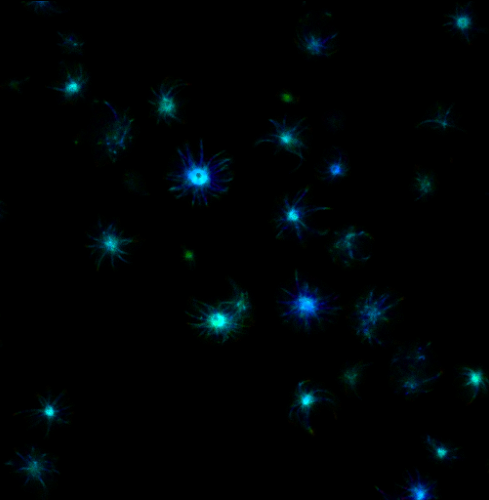
Fluorescence lifetime micrograph of a fluorescently tagged human protein inside yeast cells. Different colors indicate different states of protein aggregation.
Investigating a trade-off
The same properties that make protein self-assembly dangerous can also make it indispensable.
The Halfmann Lab has shown that immune-signaling proteins can remain in supersaturated states, storing energy until infection provides a trigger. The proteins then quickly assemble, amplifying an immune response that decides whether the cell will destroy itself to stop a pathogen from spreading.
“We wouldn’t be alive without certain proteins aggregating in response to viral infection,” Halfmann said.
But the speed comes at a cost. The longer a protein remains supersaturated, the greater the chance that a random fluctuation could trigger assembly without an infection. Misfiring may contribute to chronic inflammation, unnecessary cell death, and diseases associated with aging.
Halfmann’s team is also investigating whether some organisms have evolved ways to keep the benefit while delaying that cost.
“As clever as we try to be in thinking of ways to address disease, oftentimes we find that life has already beaten us to it,” Halfmann said.
Predicting what comes next
Halfmann’s promotion recognizes a research program that has moved from identifying unusual protein behaviors to developing technologies that reveal their physical principles, principles now applied. across inheritance, neurodegeneration, immunity, cell death, and aging.
AI can already predict many stable protein structures from amino-acid sequences. Halfmann wants to predict how these structures change over time.
Could scientists someday detect the earliest signs of disease decades before symptoms appear?
The possibilities are distant, but Halfmann believes intractable biological problems can be made understandable if you ask the right questions.
“Whenever we get a really juicy piece of data, I walk through the lab finding anybody I can to tell,” Halfmann said, “When I step back and look at how far we’ve come over the past 10 years, I get invigorated. We really are moving toward the goal.”
News
11 April 2026
Neurodegenerative diseases like Parkinson’s often begin small and then rapidly spread like wildfire. The Halfmann Lab is uncovering the places where disease begins.
Read Article
What if...?


02 April 2026
The first story in the Stowers Institute’s new ‘What if?’ campaign follows Associate Investigator Randal Halfmann, PhD, in his search to understand aging and how nature may hold clues to healthier, longer lives.
Read Article
News

20 March 2026
Understanding the brain means confronting some of biology’s toughest questions. Stowers scientists are exploring how memories last, how neurodegenerative disease begins, and how the brain’s circuitry takes shape.
Read Article