Stowers scientist selected for $28.6 million effort to predict protein changes behind neurodegenerative disease
The new award brings together a team of scientists who will combine AI, large-scale experiments and human-cell studies to predict harmful protein changes before disease takes hold.
09 October 2026
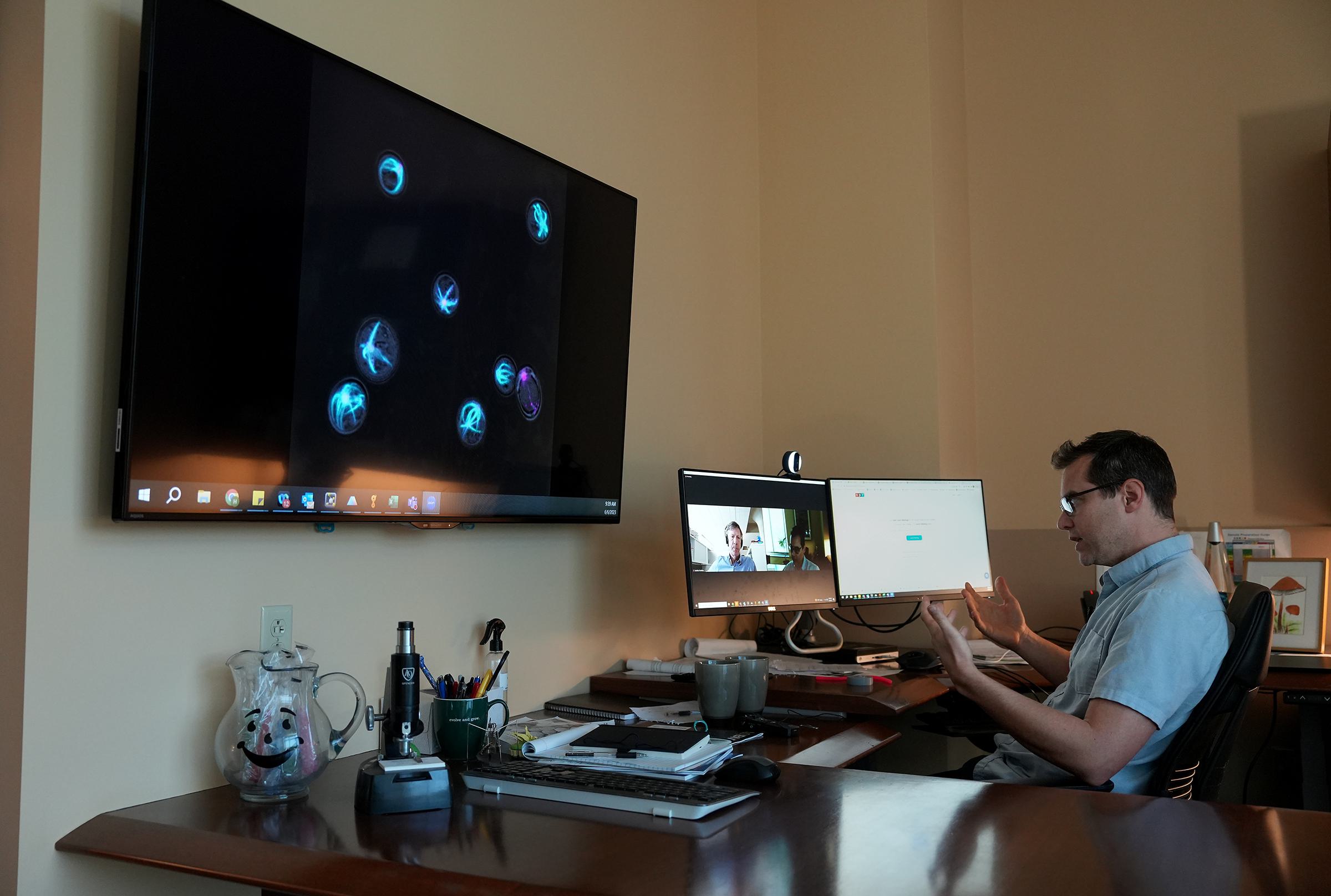
Stowers Institute Investigator Randal Halfmann, Ph.D.
KANSAS CITY, Mo. — Neurodegenerative diseases such as Alzheimer’s, Parkinson’s, ALS and Huntington’s are associated with proteins that can change shape, stick together and eventually damage cells. By the time scientists can clearly see those changes, much of the damage may already be underway.
Now, a new research effort that provides up to $28.6 million in funding will bring together a group of scientists from across the country to uncover what happens earlier in the process and train artificial intelligence to predict when proteins are likely to go wrong.
“If we can better predict the probabilities and onset ages of disease, it could allow many more people to seek preventive or early-stage treatments or enroll in clinical trials,” said Stowers Institute Investigator Randal Halfmann, Ph.D.
Halfmann and his lab will play a key role in the effort. His lab has been selected to generate large-scale experimental data on protein aggregation and will receive approximately $4.1 million over two years from the Advanced Research Projects Agency for Health, or ARPA-H.
The need for that data comes from a major gap in what AI can currently predict.
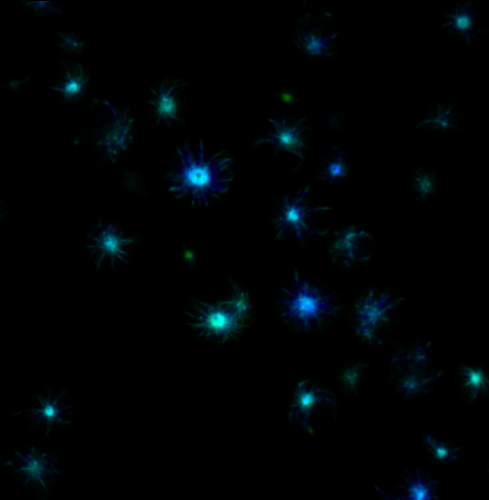
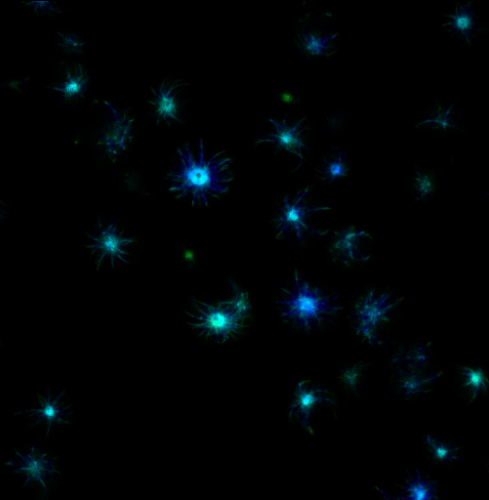
Fluorescence lifetime micrograph of a fluorescently tagged human protein inside yeast cells. Different colors indicate different states of protein aggregation.
While AI has transformed scientists’ ability to predict the structures of many proteins, roughly one-third of proteins do not have a stable structure. Such proteins, known as intrinsically disordered proteins, or IDPs, can shift among many shapes and become involved in harmful clumping, a process known as aggregation that is associated with neurodegenerative diseases. Learning how to read such proteins, even for AI, is challenging.
“Treatments for neurodegenerative diseases remain extremely limited,” Halfmann said. “Decoding the language of these IDP interactions could allow us to create therapeutic IDPs to ‘intercept’ problematic interactions that drive diseases like Alzheimer’s.”
Despite lacking a fixed structure, the behavior of IDPs is still influenced by their amino-acid sequence. Halfmann will conduct large-scale experiments in yeast to test how changes in that sequence affect whether proteins remain in their normal state or begin clumping together. His lab’s prior studies demonstrated that disease-relevant protein behavior observed in yeast can also inform how those proteins behave in human cells.
Halfmann will use Distributed Amphifluoric FRET, or DAmFRET, a technology developed by his team in 2018 that measures protein self-assembly inside individual living cells.
“Direct measurements of protein aggregation at cellular resolution have not previously been done at this scale,” Halfmann said.
Halfmann and his lab will measure the aggregation tendencies of 50,000 proteins, each individually expressed in yeast cells under diverse conditions designed to mimic the things that go wrong in human cells as we age. Across more than 1 million samples, the team expects to produce more than 10 billion measurements of protein aggregation.
“We’ve been laying the foundation for this moment since I joined Stowers in 2015,” Halfmann said. “This award comes at a time when AI stands a chance of decoding the language of IDPs, if it’s provided sufficient high-quality data, and DAmFRET has matured enough to generate that data.”
The new multi-institutional project, called NATIVE-ID, is led by the Innovative Genomics Institute at the University of California, Berkeley and is part of ARPA-H’s BIOGAMI program, a broader effort bringing together different scientific approaches to understand and ultimately control harmful protein aggregation led by ARPA-H Program Manager Shannon Greene, Ph.D.
In addition to Halfmann, the team includes scientists from UC Berkeley, Brown University, Emory University, Johns Hopkins University, Parallel Squared Technology Institute and Texas A&M University.
Animated view of a protein structure
“A deep learning model that is to decode the language of disordered proteins needs rigorously obtained data at scale, something that has yet to exist,” said Alejandro Sánchez Alvarado, Ph.D., President and Chief Scientific Officer. “Randal’s laboratory will provide what has been missing: more than 10 billion measurements of aggregation, taken one living cell at a time, across 50,000 proteins. Our colleagues at the Innovative Genomics Institute will bring the human neurons in which the model’s predictions must ultimately hold. Neither half of this project can succeed without the other. And that is what a collaboration should be.”
The group will initially focus on frontotemporal lobar degeneration, or FTLD, a neurodegenerative disease that shares significant genetic and biological features with ALS, with the larger goal of developing approaches that can apply across other diseases involving protein misfolding.
In 2023, Halfmann’s lab became the first to experimentally determine the structure of the initiating step in amyloid formation associated with Huntington’s disease. “If we can figure out exactly how it starts, then we can potentially stop this forest fire from starting in the first place,” he said at the time.
The new NATIVE-ID project builds directly on that work, which involved polyglutamine proteins associated with Huntington’s, and on the lab’s studies of TDP-43, a protein strongly associated with ALS and FTLD.
“Those were sort of pilots for this new undertaking,” Halfmann said. “In those studies, we looked at hundreds of protein sequences. Now we’re going to do 50,000.”
Other members of the NATIVE-ID team will bring complementary capabilities, including the ability to generate human neurons from different genetic backgrounds, measure protein interactions in neurons, develop advanced deep-learning frameworks, determine the structures of proteins in test tubes, and conduct large-scale computational simulations of protein behavior.
“The most interesting scientific problems rarely belong to one field or one way of thinking,” said Kausik Si, Ph.D., Scientific Director. “What makes Randal’s work distinctive is that he has built a way to ask questions about proteins that others simply could not ask before. Bringing that capability together with scientists who see the problem from completely different angles is exactly how you uncover something none of us could see on our own.”
The current award funds an initial two-year phase of work. BIOGAMI is structured in two 24-month phases, where Phase 1 delivers the foundational datasets and models, and Phase 2 focuses on validating potential therapeutics and ways to detect protein dysfunction earlier.
Read the announcement from the Innovative Genomics Institute at UC Berkeley by visiting https://innovativegenomics.org/. Read more about the award on the ARPA-H website here.
The NATIVE-ID project is led by Brad Ringeisen, Executive Director of the Innovative Genomics Institute, with Hanqin Li, head of the institute’s Advanced Translational Genetics lab. The team also includes Robert Tjian, Dirk Hockemeyer and Yun S. Song at UC Berkeley; Nicolas Fawzi at Brown University; Felipe Quiroz at Emory University; Thomas Graham at Johns Hopkins University; Mahlon Collins and Nikolai Slavov at Parallel Squared Technology Institute; Halfmann at the Stowers Institute; and Jeetain Mittal at Texas A&M University. BIOGAMI is led by ARPA-H Program Manager Shannon Greene, Ph.D.
This research was funded, in part, by the Advanced Research Projects Agency for Health (ARPA-H). The views and conclusions contained in this document are those of the authors and should not be interpreted as representing the official policies, either expressed or implied, of the U.S. Government.
About the Stowers Institute for Medical Research
Founded in 1994 through the generosity of Jim Stowers, founder of American Century Investments, and his wife, Virginia, the Stowers Institute for Medical Research is a non-profit, biomedical research organization with a focus on foundational research. Its mission is to expand our understanding of the secrets of life and improve life’s quality through innovative approaches to the causes, treatment, and prevention of diseases.
The Institute consists of more than 20 independent research programs. Of the approximately 500 members, over 370 are scientific staff that include principal investigators, fellows, technology center directors, postdoctoral scientists, graduate students, and technical support staff. Learn more about the Institute at stowers.org and about its graduate program at stowers.org/gradschool.
Media Contact: Joe Chiodo Director of Communications Stowers Institute for Medical Research 724-462-8529 joe.chiodo@stowers.org